
In a new study published in Environmental Health Perspectives, a team of researchers investigated the potential connection between exposure to flame retardant chemicals found in household products— called PFRs — and pregnancy.
While we can’t conclude from the results that products like yoga mats cause infertility, the findings bolster pre-existing research suggesting an association between PFRs and reproductive complications.
What are PFRs?
PFRs (organophosphate flame retardants) are a class of chemicals that are commonly used in the polyurethane foam in upholstered furniture, baby products such as nursing pillows, bouncers, and swings, and yoga mats (to name a few) to make them less flammable
What’s the risk with PFRs?
They can spread from the foam into the air and dust. Considering the ubiquity of PFR-containing products, we likely inhale the chemicals on a regular basis without even knowing it.
Although scientists don’t yet have enough conclusive evidence to say that PFRs are bad for our overall health, a growing body of research suggests exposure to PFRs can disrupt the hormones involved in reproduction and embryo/fetus growth.
This new study expanded the evidence base by specifically looking at possible connections between exposure to PFRs and pregnancy.
What did the study involve and what did they find?
A team of researchers, including Mass General’s Russ Hauser, MD, MPH, ScD, followed 211 women who went to the Mass General Fertility Center to be evaluated for in vitro fertilization (IVF).
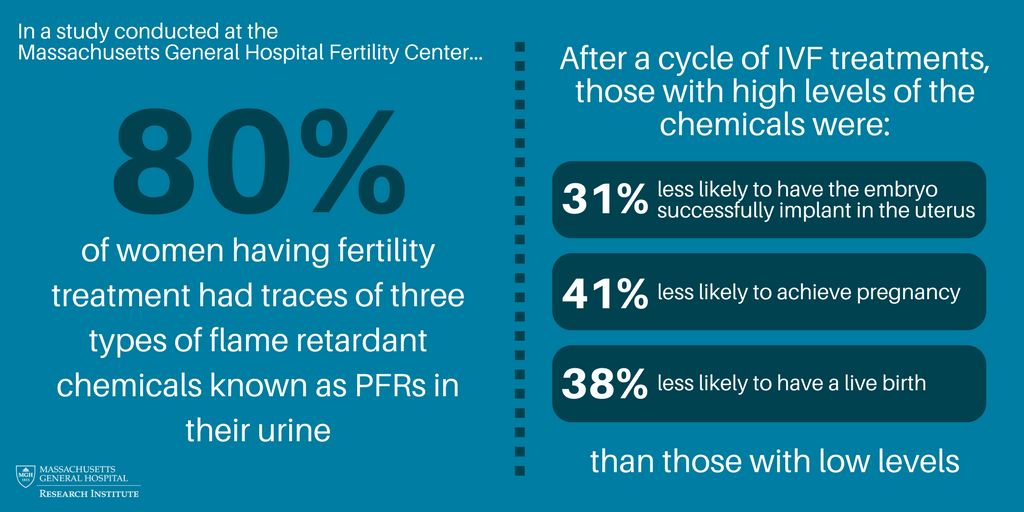
The researchers checked the women’s urine for traces of PFRs and found that more than 80% of the women had traces of three types PFRs in their urine.
After a cycle of IVF treatments, those with high levels of the chemicals were 31% less likely to have the embryo successfully implant in the uterus, 41% less likely to achieve pregnancy, and a 38% less likely to have a live birth than those with low levels.
What do the results mean?
The research team looked at the correlation between traces of PFR and pregnancy outcomes but did not study whether PFR exposure was the cause of pregnancy complications. Thus, we can’t conclude that exposure to PFR-containing products leads to infertility.
However, the findings suggest an association between high levels of PFR exposure and poor pregnancy outcomes. Additionally, because researchers didn’t look at which specific PFR-containing products were the source of the chemical exposure, we can’t single out yoga mats or sofas as the culprits.
Are there limitations to the study?
The study participants were drawn from a small pool of women who were living in and around Boston, so it is not representative of the population at large. Plus, all participants were recruited from an IVF clinic, which suggests they many participants were predisposed to fertility issues coming into the study
What’s next?
There’s an ongoing debate about the rational for putting flame retardants like PFRs in household products. Studies like this one provide compelling evidence for a potential association between PFR exposure and negative health outcomes like infertility, though more research needs to be conducted.
There are also questions as to how effectively PFRs prevent fires. In 2010, a group of 145 scientists from 22 countries published a statement detailing their concerns that flame retardants weren’t worth the health risks they posed.
What can people do to protect themselves in the meantime?
While it’s nearly impossible to fully avoid PFRs, consumers can minimize exposure by looking for products that have a natural flame retardant like leather or wool fabric, or seek out organic yoga mats.
In a Huffington Post article, lead author Courtney Carignan of the Harvard T. Chan School for Public Health said that other precautions, like good-hand washing practices before meals, can also help lower levels of these chemicals in the body.
About the Mass General Research Institute
Massachusetts General Hospital is home to the largest hospital-based research program in the United States. Our researchers work side-by-side with physicians to develop innovative new ways to diagnose, treat and prevent disease.
Support our research


I think this research is in doubt. Is it? Are you sure PFR is causing pregnancy complication ?
Hi Tanveer. Thanks for asking! The research suggests that there could be an association between PFRs and reproductive complications, but based on what we know right now, we can’t say that PFR exposure causes infertility.
If i think, it is based on a question related to sample selection. Your selected samples are belong a particular area. what Would you say?
Agreed. The results aren’t generalizable to the broader population.