
Science news and discoveries from the Mass General Research Institute
Bench PressBench PressBench PressBench Press
  • Home
  • About
  • Research
    • COVID-19
    • Brain
    • Heart
    • Cancer
    • More…
  • Communicating Science
  • Events
  • Subscribe

How a 3D Model of Alzheimer’s Disease is Providing New Hope in the Search for Treatments

    Home Neurology Alzheimer's Disease How a 3D Model of Alzheimer’s Disease is Providing New Hope in the Search for Treatments

    How a 3D Model of Alzheimer’s Disease is Providing New Hope in the Search for Treatments

    By mghresearch | Alzheimer's Disease, Neurology | 1 comment | 30 October, 2017 | 0

    Reigning in Alzheimer’s disease continues to be a challenge — more than 10 million families are affected by this degenerative neurological disease, and the number of patients dying from the disease has increased 68 percent since 2010.

    In the past decade, attempts at developing drugs to slow or halt the progression of Alzheimer’s disease have been unsuccessful. The traditional path for early testing of promising therapies – mouse models – has been ineffective, and more than a dozen major clinical trials have failed.

    But scientists and clinicians at Massachusetts General Hospital’s Institute for Neurodegenerative Disease (MIND) have developed an innovative new approach that could significantly improve the drug development process.

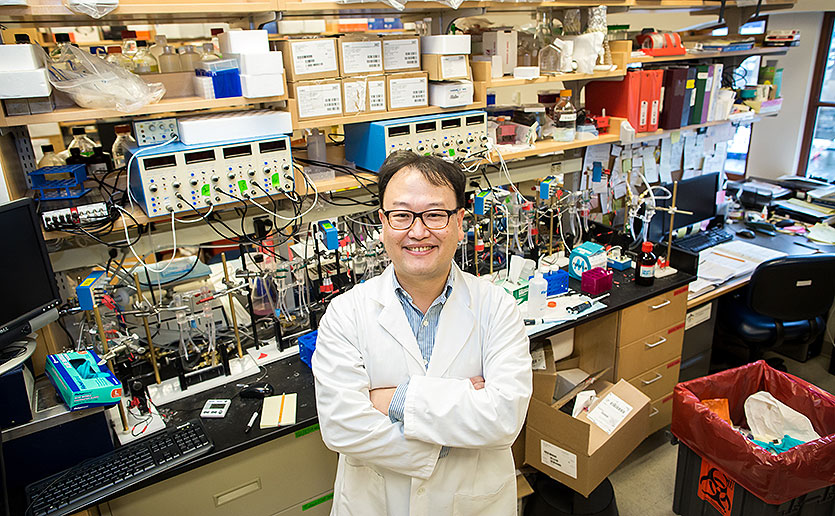
    The laboratory teams of Doo Yeon Kim, PhD, an investigator in the Genetics and Aging Research Unit at MIND, and Rudy Tanzi, PhD, have found a way to grow human neural stem cells in a three-dimensional gel matrix.

    This gel system allows the neural cells to grow more naturally and form into 3-D networks just like they do in the brain. It also provides a more accurate model of the signature plaques and tangles that develop around these neurons in Alzheimer’s disease.

    The stem cells used in this lab model are genetically engineered to produce two proteins that are the hallmarks of Alzheimer’s disease – β-amyloid and tau. In the brains of people with Alzheimer’s, excessive accumulation of β-amyloid results in the formation of plaques in the spaces between neural cells, while tau is the main component of destructive neurofibrillary tangles within the cells.

    Until Dr. Kim’s success, no single model of Alzheimer’s disease contained both amyloid plaques and neurofibrillary tangles. It usually takes a year to develop plaques in mouse models, it took only six weeks to develop both plaques and tangles in the “dish.”

    Dr. Kim is now working with a consortium of labs to test thousands of FDA-approved drugs in this “Alzheimer’s in a dish” model to see if any of the drugs are effective in reducing levels of p-tau, a protein that is increased in Alzheimer’s patients.

    Of the 2,400 drugs that have been tested, the team had approximately 40 promising hits that they can now investigate further.

    Learn More

    About the Mass General Research Institute
    Massachusetts General Hospital is home to the largest hospital-based research program in the United States. Our researchers work side-by-side with physicians to develop innovative new ways to diagnose, treat and prevent disease.
    Support our research

    No tags.

    Related Post

    • To Mars and Beyond: Exploring Innovative Solutions to the Challenges of Space Travel

      By mghresearch | 1 comment

      If you could only bring two shoeboxes worth of medical supplies—from first aid kits to surgical tools— with you on a three-year space mission, what would you bring?

    • Are You Actually Allergic to Penicillin? Researchers Find New Methods to Confirm Antibiotic Allergies

      By mghresearch | 0 comment

      Mass General researchers are working to increase the safe use of penicillins in patients who have a recorded penicillin allergy but are not actually allergic.

    • Re-Thinking Mental Health Treatment: World Health Day 2017

      By mghresearch | 0 comment

      Did you know that more than 300 million people worldwide live with depression? That number has increased 18% between 2005 and 2015, according to the World Health Organization (WHO). With such staggering numbers, it’s no surprise that WHO has chosen depression as its theme for this year’s World Health Day, which is celebrated today, April 7th.

    • New Study Finds Low-Dose Aspirin May Lower Risk of Cancer Death

      By mghresearch | 1 comment

      A new study from Massachusetts General Hospital reports that long-term regular aspirin was associated with a lower risk of dying from various types of cancers.

    • Mass General Stands Up for Science

      By mghresearch | 0 comment

      The Boston March for Science will celebrate the discovery, understanding and sharing of scientific knowledge. Several groups from Massachusetts General Hospital are working together to organize and ensure a strong presence to reaffirm the message about the essential role that science – biomedical research, in particular – plays in improving life and health.

    • Adhering to Treatment During Adolescence Keeps HIV-Positive Youth on a Healthier Track

      By mghresearch | 0 comment

      Individuals born with HIV are more likely to have difficulty managing their treatment as teens and young adults than they did as children.

    • Celebrating the Role of Women in Science and Much More

      By mghresearch | 2 comments

      Interested in the newest research studies and hot topics? Check out the latest issues of “From the Lab Bench”, a monthly newsletter from the Office of the Scientific Director at the Mass General Research Institute, and “Research Roundup”, our monthly recap of the latest biomedical research news.

    • Research Rumble Recap and the Art of Effective Science Communication

      By mghresearch | 1 comment

      Last night five researchers from Massachusetts General Hospital and Brigham and Women’s Hospital showed off their science communication skills in a Research Rumble at the Cambridge Public Library as part of Cambridge Science Festival. Co-DirectorRead more

    Leave a Comment

    Cancel reply

    Your email address will not be published. Required fields are marked *

    Categories

    Social

    Tags

    adolescents aging allergies ALS artificial intelligence brain health cancer treatments child health cholera clinical research clinical trials community health coronavirus dementia diagnostic tools diversity exercise Harvard health disparities heart attacks heart disease heart failure heart month hypertension image contest innovation internships kidney disease machine learning martinos center memory mental health microbiome Munn Center for Nursing Research nursing PET imaging postdocs public health Ragon Institute rare diseases researchers science writing sleep women's health women in medicine

    Copyright 2020
    Mass General Research Institute
    All Rights Reserved

    SUBSCRIBE TO BENCH PRESS


    Contact

    Mass General Research Institute
    125 Nashua St.
    Boston, MA 02114
    617-724-0200
    researchinstitute@mgh.harvard.edu
    M-F: 9:00 am - 5:00 pm
    • Home
    • About
    • Research
      • Brain
      • Cancer
      • Heart
    • Communicating Science
    • Events
    • Home
    • About
    • Research
      • Brain
      • Cancer
      • Heart
      • More…
    • Communicating Science
    • Events
    Bench Press