
If you’re among the 50 million Americans with a severe allergy to foods like gluten or nuts, every meal at a restaurant can feel like a potential land mine. Even if the restaurant has made an effort to provide dishes that are allergen-free, worries of cross-contamination and a subsequent severe or potentially life threatening reaction can still put a damper on your dinner plans.
To help ease concerns and keep food allergy sufferers safe, a team of researchers at Massachusetts General Hospital has developed a new device small enough to fit on a keyring that costs only $40 and can quickly and accurately test for food allergens.
While advances have been made in the packaged food industry, where new federal regulations require the manufacturer to disclose whether the product contains major food allergens, these disclosures are not always accurate and there are no similar regulations for the restaurant industry.
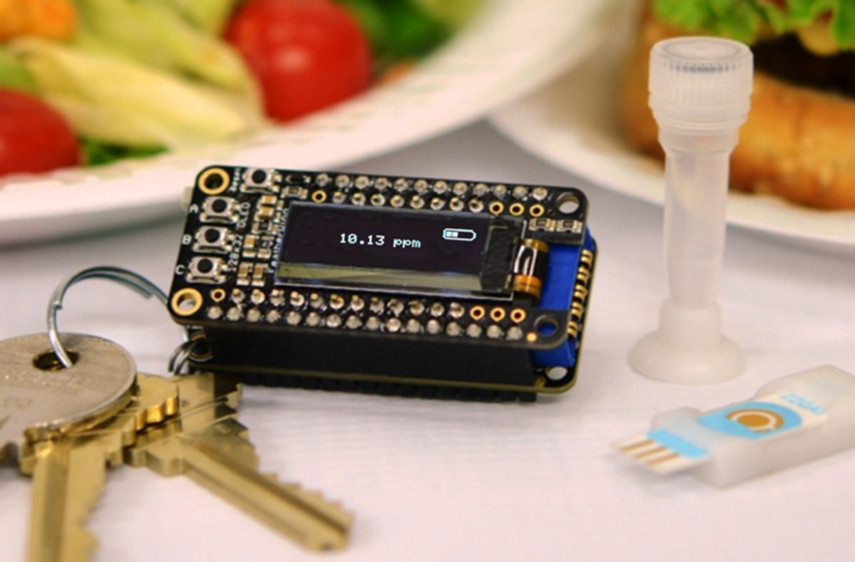
Rather than force diners to completely avoid foods that have the chance of containing an allergen, or eat something only to regret it later, Mass General researchers created integrated exogenous antigen testing (iEAT), a pocket-sized device that can accurately analyze food for the presences of allergens in less than 10 minutes. Specifically, the device can screen for peanuts, hazelnuts, wheat, milk and eggs.
Developed by co-senior team leaders Ralph Weissleder, MD, PhD, Director of the Center for Systems Biology (CSB) at Mass General and Hakho Lee, PhD, Hostetter MGH Research Scholar and Director of the Biomedical Engineering Program at the CSB, the device consists of three components:
- A small plastic test tube that the user can put a small sample of food into. The tube contains a solution that dissolves the sample and adds magnetic beads to the solution. The beads are designed to bind to the food allergen of interest.
- The user can then drop the solution onto an electrode chip, which is inserted into the keychain sized reader.
- The reader analyzes the sample and indicates on a small display whether the allergen is present, and if so, in what concentration.
Testing performed by the research team showed that measurements of the concentration of the allergen is extremely accurate. In fact, the device could detect levels of gluten that were 200 times lower than the federal standard. Accuracy is key because everyone’s sensitivity varies — some individuals could experience a reaction after consuming a miniscule trace of an allergen.
Weissleder and Lee have also developed a smartphone app to complement iEAT. With the app, users can compile and store the data they collect as they test different foods for various allergens at different restaurants and even in packaged foods. The app is set up to share this information online so others with the app will be able to find restaurants with foods that consistently have no or low levels that are below the individual’s triggering concentration.
Consumers may be able to purchase the $40 iEAT device and corresponding app in the near future — the research team has granted a license to a local start-up company to make the system commercially available. Weissleder and Lee also report that they could apply this technology to detect other substances in food such as MSG or even pesticides.
This research was recently highlighted in an NIH article and published in ACS Nano.
It was also recently featured in a news story on CBS Boston.
About the Mass General Research Institute
Massachusetts General Hospital is home to the largest hospital-based research program in the United States. Our researchers work side-by-side with physicians to develop innovative new ways to diagnose, treat and prevent disease.
Support our research


Leave a Comment