
Science news and discoveries from the Mass General Research Institute
Bench PressBench PressBench PressBench Press
  • Home
  • About
  • Research
    • COVID-19
    • Brain
    • Heart
    • Cancer
    • More…
  • Communicating Science
  • Events
  • Subscribe

Researchers Use Machine Learning to Improve Breast Cancer Screening Techniques

By mghresearch | Cancer, Technology | 0 comment | 10 November, 2017 | 0

Imagine enduring a painful, expensive and scar-inducing surgery—only to find out afterwards that it wasn’t necessary.

This is the situation for many women with high-risk breast lesions—areas of tissue that appear suspicious on a mammogram and have abnormal but not cancerous cells when tested by needle biopsy. Following surgical removal, 90% of these lesions end up being benign.

A change in the standard of care could be on the horizon thanks to researchers at Massachusetts General Hospital and MIT’s Computer Science and Artificial Intelligence Laboratory (CSAIL) who have found a more precise and less invasive way to separate harmful lesions from benign ones.

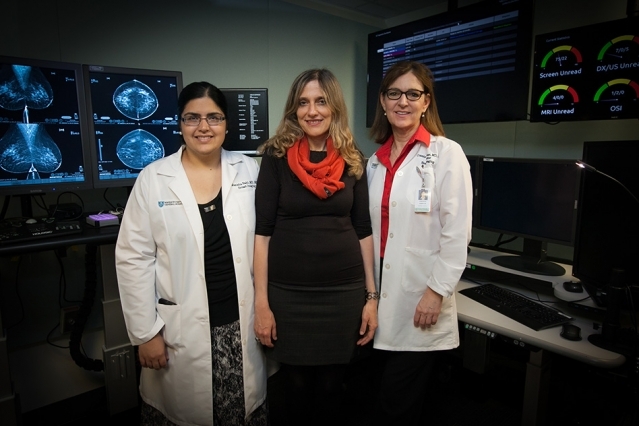
“The decision about whether or not to proceed to surgery is challenging, and the tendency is to aggressively treat these lesions [and remove them],” said Manisha Bahl, MD, Director of the Breast Imaging Fellowship Program at Mass General, in a recent interview.

Bahl, along with a team of researchers, have harnessed the power of artificial intelligence (AI) to develop a more accurate and less invasive screening method for high-risk lesions.

When tested, the machine correctly diagnosed 97 percent of 335 high-risk breast lesions as malignant and reduced the number of benign surgeries by more than 30 percent compared to existing approaches. These results were recently published in Radiology.

The team developed an AI system that uses machine learning to distinguish between high-risk lesions that need to be surgically removed from those that should just be watched over time.

They created this model by feeding it data on over 600 high-risk lesions, including information on the patient’s demographics and pathology reports, and then tasked it to identify patterns among the different data elements.

Through a process called deep learning, the machine uses the data to create an algorithm that can be used to predict which high-risk lesions should be surgically removed.

This process differs from traditional software programming in that the researchers did not give the machine the formula for diagnosis, but rather let it analyze the data and identify patterns on its own.

“To our knowledge, this is the first study to apply machine learning to the task of distinguishing high-risk lesions that need surgery from those that don’t,” said collaborator Constance Lehman, MD, PhD, chief of the Breast Imaging Division at Mass General’s Department of Radiology, in a recent interview.

“We believe this could support women to make more informed decisions about their treatment and that we could provide more targeted approaches to health care in general.”

Lehman says Mass General radiologists will begin incorporating the model into their clinical practice over the next year.


About the Mass General Research Institute
Massachusetts General Hospital is home to the largest hospital-based research program in the United States. Our researchers work side-by-side with physicians to develop innovative new ways to diagnose, treat and prevent disease.
Support our research

artificial intelligence, breast cancer, cancer screening, machine learning

Related Post

  • Breast Cancer Screening Research Highlights How Flawed Science Contributes to Health Disparities

    By mghresearch | 0 comment

    Study highlights the pitfalls of basing clinical recommendations on data heavily skewed towards one race or ethnic group.

  • Woman with insomnia

    Wireless Sleep Monitoring System Could Make Sleep Studies Much Easier

    By mghresearch | 0 comment

    Researchers from MIT and Mass General recently unveiled a wireless, portable system for monitoring individuals during sleep that could provide new insights into sleep disorders and reduce the need for time and cost-intensive overnight sleep studies in a clinical sleep lab.

  • HUBweek Art of Talking Science Competition Recap

    By mghresearch | 0 comment

    A recap of our second annual Art of Talking Science Competition, which focused on AI and machine learning.

  • Artificial Intelligence Makes Waves in Healthcare

    By mghresearch | 0 comment

    There’s so much more to artificial intelligence (AI) than what you’ve seen in sci-fi movies. In fact, advancements in machine learning could provide new opportunities for medical research and diagnosis.

  • How Chest X-Rays Could Provide New Clues About Your Future Health Risks

    By mghresearch | 0 comment

    While one person may not be able to analyze and process all that information, computers powered by artificial intelligence (AI) can help.

Leave a Comment

Cancel reply

Your email address will not be published. Required fields are marked *

Categories

Social

Tags

adolescents aging allergies ALS artificial intelligence brain health cancer treatments child health cholera clinical research clinical trials community health coronavirus dementia diagnostic tools diversity exercise Harvard health disparities heart attacks heart disease heart failure heart month hypertension image contest innovation internships kidney disease machine learning martinos center memory mental health microbiome Munn Center for Nursing Research nursing PET imaging postdocs public health Ragon Institute rare diseases researchers science writing sleep women's health women in medicine

Copyright 2020
Mass General Research Institute
All Rights Reserved

SUBSCRIBE TO BENCH PRESS


Contact

Mass General Research Institute
125 Nashua St.
Boston, MA 02114
617-724-0200
researchinstitute@mgh.harvard.edu
M-F: 9:00 am - 5:00 pm
  • Home
  • About
  • Research
    • Brain
    • Cancer
    • Heart
  • Communicating Science
  • Events
  • Home
  • About
  • Research
    • Brain
    • Cancer
    • Heart
    • More…
  • Communicating Science
  • Events
Bench Press