
Science news and discoveries from the Mass General Research Institute
Bench PressBench PressBench PressBench Press
  • Home
  • About
  • Research
    • COVID-19
    • Brain
    • Heart
    • Cancer
    • More…
  • Communicating Science
  • Events
  • Subscribe

Research Your Resolution: Use Food Placement to Set Yourself Up for Weight Loss Success

    Home Medicine Gastroenterology Obesity Research Your Resolution: Use Food Placement to Set Yourself Up for Weight Loss Success

    Research Your Resolution: Use Food Placement to Set Yourself Up for Weight Loss Success

    By mghresearch | Obesity | 0 comment | 4 January, 2018 | 0

    Do you have goals for improving your health in the New Year? This month, investigators from the Mass General Research Institute are discussing the science behind some common New Year’s resolutions, and offering tips and advice based on their research into exercise, diet, healthy aging, heart health, and much more.

    Anne Thorndike, MD
    Anne Thorndike, MD, MPH

    Anne Thorndike, MD, MPH, is an investigator in the Department of Medicine at Massachusetts General Hospital. Her research uses the principles of behavioral economics to develop strategies to encourage healthy food choices at home, in the workplace and in community settings. To learn more about her work, please visit her physician profile page.

    Sticking to a healthy diet is difficult when you are exposed to unhealthy food choices on every street corner, restaurant, shelf and snack drawer.

    It is even more difficult to make healthy food choices when you are busy, hungry, stressed or tired.

    Using “point-of-purchase” nutrition information, such as menu calorie labels, and restructuring your home food environment are two strategies that can help you achieve your New Year’s goals.

    For example, if that burrito you are thinking about for lunch has 1,000 calories, maybe it isn’t the best choice—it will give you approximately half a day’s worth of calories if you are a man, and more than half if you are a woman.

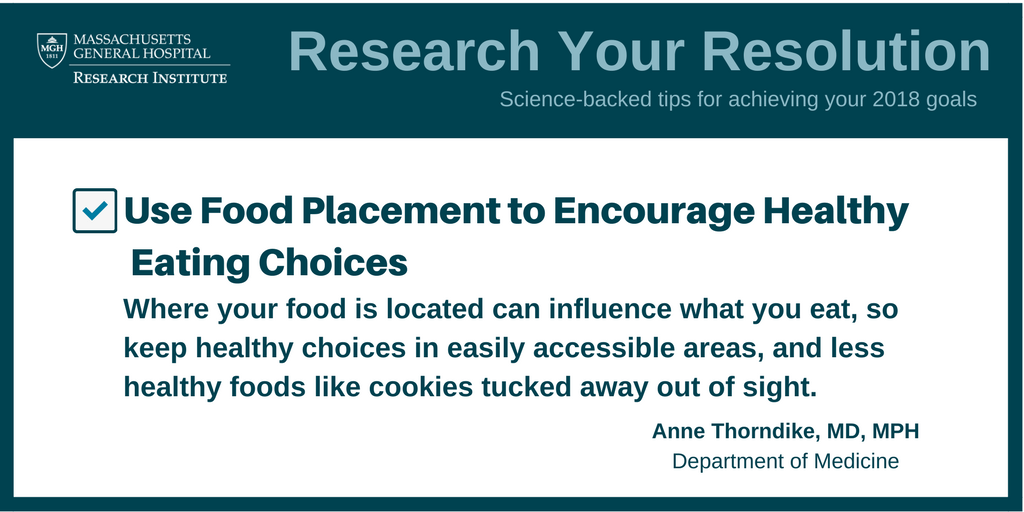
    At home, you can engineer your kitchen to make healthy foods more convenient—and unhealthy foods harder to reach.

    Put healthy snacks at eye level on the shelf, and hide the cookies on the top shelf.  Better yet, don’t even bring the cookies into the house!

    Our research in the cafeterias at Mass General showed that labeling foods with simple traffic-light labels (red=unhealthy; green=healthy), and placing healthy foods in highly visible and convenient locations prompted cafeteria customers to make more healthy food choices (e.g. bottled water, salads) and fewer unhealthy items (e.g. soda, pizza).

    In other research, we showed that placing fresh fruits and vegetables near the front of small urban food stores increased produce purchases by low-income families.

    About the Mass General Research Institute
    Massachusetts General Hospital is home to the largest hospital-based research program in the United States. Our researchers work side-by-side with physicians to develop innovative new ways to diagnose, treat and prevent disease.
    Support our research

    new year's resolutions, weight loss

    Related Post

    • Mass General Researcher Resolutions

      By gir0 | 0 comment

      In the spirit of New Year’s resolutions, we reached out to a few of our top researchers at Mass General to hear about their proudest moments from 2018 and what they look forward to accomplishing in 2019.

    • Research Your Resolution: Maintain an Exercise Routine for Health Benefits Beyond Weight Loss

      By mghresearch | 0 comment

      Fatima Cody Stanford, MD, MPH, MPA, FAAP, FACP, FTOS Fatima Cody Stanford, MD, MPH, MPA, FAAP, FACP, FTOS, is an Obesity Medicine Physician at the Massachusetts General Hospital Weight Center, an Associate at the Mass General Disparities Solution Center,Read more

    • Research Your Resolution: Take a Slow and Steady Approach to Losing Weight

      By mghresearch | 0 comment

      If your goal for the New Year is losing weight, I recommend finding eating and exercise behaviors that lead to a steady weight loss week to week, even if the pace at which you are losing weight is slow.

    Leave a Comment

    Cancel reply

    Your email address will not be published. Required fields are marked *

    Categories

    Social

    Tags

    adolescents aging allergies ALS artificial intelligence brain health cancer treatments child health cholera clinical research clinical trials community health coronavirus dementia diagnostic tools diversity exercise Harvard health disparities heart attacks heart disease heart failure heart month hypertension image contest innovation internships kidney disease machine learning martinos center memory mental health microbiome Munn Center for Nursing Research nursing PET imaging postdocs public health Ragon Institute rare diseases researchers science writing sleep women's health women in medicine

    Copyright 2020
    Mass General Research Institute
    All Rights Reserved

    SUBSCRIBE TO BENCH PRESS


    Contact

    Mass General Research Institute
    125 Nashua St.
    Boston, MA 02114
    617-724-0200
    researchinstitute@mgh.harvard.edu
    M-F: 9:00 am - 5:00 pm
    • Home
    • About
    • Research
      • Brain
      • Cancer
      • Heart
    • Communicating Science
    • Events
    • Home
    • About
    • Research
      • Brain
      • Cancer
      • Heart
      • More…
    • Communicating Science
    • Events
    Bench Press