
Science news and discoveries from the Mass General Research Institute
Bench PressBench PressBench PressBench Press
  • Home
  • About
  • Research
    • COVID-19
    • Brain
    • Heart
    • Cancer
    • More…
  • Communicating Science
  • Events
  • Subscribe

Research Your Resolution: Take a Slow and Steady Approach to Losing Weight

    Home Medicine Gastroenterology Obesity Research Your Resolution: Take a Slow and Steady Approach to Losing Weight

    Research Your Resolution: Take a Slow and Steady Approach to Losing Weight

    By mghresearch | Obesity | 0 comment | 15 January, 2018 | 0
    Emily_Feig
    Emily Feig, PhD

    Emily Feig, PhD, is a clinical research fellow in the Department of Psychiatry at Massachusetts General Hospital.

    Dr. Feig recently published the results of a study she conducted as a doctoral student at Drexel University showing that individuals who maintained a steady rate of losing weight during the first few months of a behavioral weight loss program had better long term results than individuals who fluctuated in the amount they lost from week to week.

    Read More

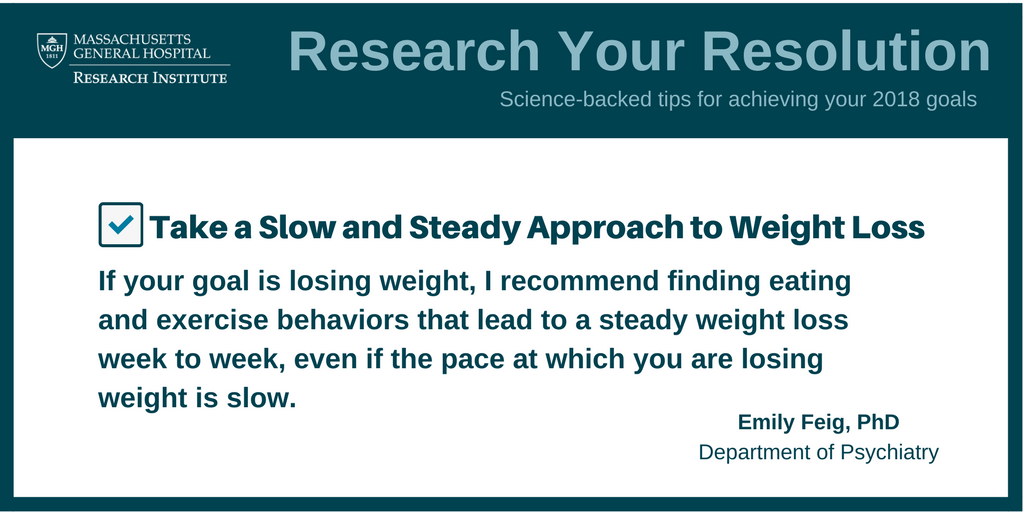
    If your goal for the New Year is losing weight, I recommend finding eating and exercise behaviors that lead to a steady weight loss week to week, even if the pace at which you are losing weight is slow.

    For example, you might commit to bringing a healthy afternoon snack to work to replace stopping at the vending machine, setting a “kitchen closed” time when evening snacking will end, adding a vegetable to dinner five nights a week, or setting aside an hour each weekend to plan ahead for meals the next week.

    By keeping track of how different behaviors affect your weight, you can adjust to find what leads to a slow and steady weight loss pace for you.

    This is because we found that, in a sample of 183 participants in a behavioral weight loss program, better long-term weight loss at one and two years was achieved by those who lost weight at a consistent pace during the first few months of the program, compared to those whose weights varied more week to week.

    So finding healthy behaviors that lead to a slow and steady rate of weight loss is likely a key factor in keeping the weight off long-term.


    Research Your Resolution

    Do you have goals for improving your health in the New Year? This month, investigators from the Mass General Research Institute are discussing the science behind some common New Year’s resolutions, and offering tips and advice based on their research into exercise, diet, healthy aging, heart health, and much more.

    Massachusetts General Hospital is home to the largest hospital-based research program in the United States, a community of more than 10,000 people working across 30 departments, centers and institutes. The Mass General Research Institute works to support, guide and promote these research initiatives.


    About the Mass General Research Institute
    Massachusetts General Hospital is home to the largest hospital-based research program in the United States. Our researchers work side-by-side with physicians to develop innovative new ways to diagnose, treat and prevent disease.
    Support our research

    weight loss

    Related Post

    • Research Your Resolution: Maintain an Exercise Routine for Health Benefits Beyond Weight Loss

      By mghresearch | 0 comment

      Fatima Cody Stanford, MD, MPH, MPA, FAAP, FACP, FTOS Fatima Cody Stanford, MD, MPH, MPA, FAAP, FACP, FTOS, is an Obesity Medicine Physician at the Massachusetts General Hospital Weight Center, an Associate at the Mass General Disparities Solution Center,Read more

    • Research Your Resolution: Use Food Placement to Set Yourself Up for Weight Loss Success

      By mghresearch | 0 comment

      Do you have goals for improving your health in the New Year? This month, investigators from the Mass General Research Institute are discussing the science behind some common New Year’s resolutions, and offering tips and advice based on their research into exercise, diet, healthy aging, heart health, and much more.

    Leave a Comment

    Cancel reply

    Your email address will not be published. Required fields are marked *

    Categories

    Social

    Tags

    adolescents aging allergies ALS artificial intelligence brain health cancer treatments child health cholera clinical research clinical trials community health coronavirus dementia diagnostic tools diversity exercise Harvard health disparities heart attacks heart disease heart failure heart month hypertension image contest innovation internships kidney disease machine learning martinos center memory mental health microbiome Munn Center for Nursing Research nursing PET imaging postdocs public health Ragon Institute rare diseases researchers science writing sleep women's health women in medicine

    Copyright 2020
    Mass General Research Institute
    All Rights Reserved

    SUBSCRIBE TO BENCH PRESS


    Contact

    Mass General Research Institute
    125 Nashua St.
    Boston, MA 02114
    617-724-0200
    researchinstitute@mgh.harvard.edu
    M-F: 9:00 am - 5:00 pm
    • Home
    • About
    • Research
      • Brain
      • Cancer
      • Heart
    • Communicating Science
    • Events
    • Home
    • About
    • Research
      • Brain
      • Cancer
      • Heart
      • More…
    • Communicating Science
    • Events
    Bench Press