
During the month of March, Massachusetts General Hospital is celebrating Women’s History Month by highlighting our outstanding women scientists, physicians and staff members. In the coming weeks we’ll be sharing a few of their profiles, and be sure to visit the women’s history month landing page to see the full series.
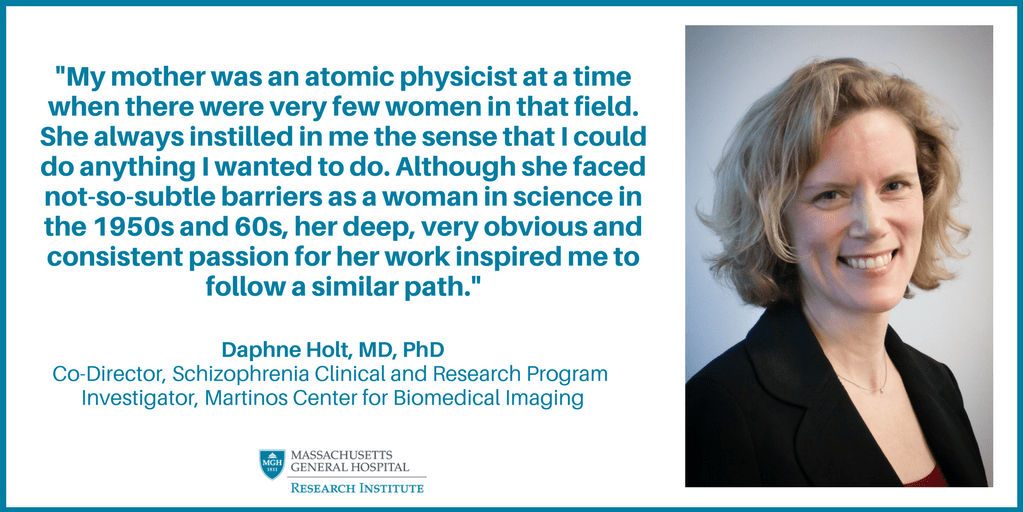 Daphne Holt, MD, PhD
Co-Director, Schizophrenia Clinical and Research Program, Department of Psychiatry, Massachusetts General Hospital
Investigator, Martinos Center for Biomedical Imaging
Associate Professor of Psychiatry,
Harvard Medical School
Dr. Holt is using brain imaging technology to learn more about how individuals with schizophrenia process and respond to perceived intrusions into their personal space.
Abnormalities in this type of basic behavior, and other, related forms of non-verbal social communication, have been linked to some of the most disabling symptoms of schizophrenia, such as the social withdrawal that occurs early and is often persistent despite conventional treatment.
Her goal is to create new screening tools that could help to identify these symptoms earlier, when they first emerge, and to guide the development of new treatment strategies that address these processing differences and symptoms.
She was a 2014 winner of a Claflin Distinguished Scholar Award. The Claflin Awards were established by the hospital to support women researchers as they balance the dual demands of career and family
What is special about Mass General?
I have always found Mass General to be a really exciting place, because it is possible to do so much really interesting and innovative work in both the research and clinical domains. At the same time, Mass General also maintains some of the feeling of a small community, in part because so many faculty trained here and stayed on.
There is a sense of continuity and history with the people and the institution as a whole, as well as a strong push towards growth and progress.
What do you like most about your job?
I like working with smart, collaborative people who know things I don’t know (both faculty and trainees) – we get to come up with new ideas together and then see them implemented pretty quickly in research or clinical practice.
In the research part of my job, I feel very lucky that I get to ask questions about how the brain works (or doesn’t), find some tentative answers in our data, and then I have the job of trying to understand those answers and explain them to other people, which can be both interesting and challenging.
What advice would you give to women entering the field of medicine and/or healthcare?
I would advise anyone (not just women) to try to be as persistent and resilient in the face of challenges as you can, to maintain a consistent belief in what you want to do and what seems important to you to accomplish. Of course this is easier said than done, but this is a skill that can be learned to some extent.
At the same time, it’s also important to have the ability to receive feedback and be flexible while continuing to move forward – to be able adjust to unexpected barriers as well as take advantage of new opportunities.
Advice that might be more frequently applicable to women, who are sometimes particularly anxious to please others: While it is important to be collaborative and a “team player” in many situations, at the same time, try to keep an eye on your own long term goals. In fact, it is often the case (people don’t always realize) that the successful pursuit of your own goals can be synergistic with and beneficial to the goals of the larger group.
Has there been an influential woman in your life who supported or inspired you on your journey into health care/medicine?
My mother was an extraordinary woman who was a great role model for me. She was an atomic physicist at a time when there were very few women in that field. She always instilled in me the sense that I could do anything I wanted to do.
Although she faced not-so-subtle barriers as a woman in science (in the 1950s and 60s), her deep, very obvious and consistent passion for her work inspired me to follow a similar path.
How can we encourage more women and girls to enter the sciences?
We can expose girls early to the fun parts of science and to happy and confident female scientists. We can also try to dispel certain beliefs and stereotypes about what a scientist is supposed to be like, and what makes a good scientist, highlighting that there is diversity within science in terms of the talents and skills that are valuable to have.


Leave a Comment