
Researchers at Massachusetts General Hospital have developed a new technique for imaging the brains of patients with amyotrophic lateral sclerosis (ALS) that could vastly reduce the cost and time needed for new clinical trials—while also improving the accuracy of test results.
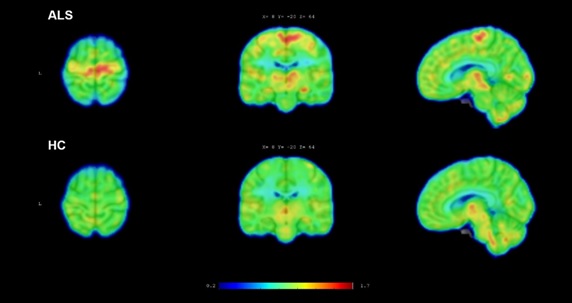
Nazem Atassi, MD, the Associate Director of the Neurological Clinical Research Institute (NCRI) at Mass General, led the team that developed the new imaging protocol, which uses an injectable radioactive tracer called PBR28 to measure levels of neuroinflammation in the motor cortex of ALS patients.
The motor cortex controls voluntary muscle movements and is the area of the brain most affected by the disease.
The new imaging protocol can reduce the number of patients needed for a clinical trial from 400 to 30; shorten the duration of the trial from 1-2 years to 2-3 months; and provide an objective biological measure of the experimental treatment effect. This should help to reduce some common obstacles in ALS trials by shortening timelines and reducing costs.
How It Works
A radiotracer is a short-lived radioactive agent that can be injected into a patient to measure different types of biological activity. Of the several radiotracers Atassi and his team tested, PBR28 was the most successful in binding to areas of neuroinflammation in the motor cortex of ALS patients.
“We tested it in 3-5 patients at the beginning, and we saw a strong signal,” Atassi said. “Then we increased the numbers to 10 patients and 10 healthy volunteers, and now we’ve published on big cohort of 85+ people. It took us 5-6 years to validate all this data, and now we’re in place to use the tracer in ALS clinical trials.” The NCRI now has four clinical trials running that will use this imaging protocol to assess the effectiveness of treatments.
With the ability to measure the uptake of PBR28 before, during and after treatment in Phase 2 clinical trials, investigators can now determine how potential treatments for ALS impact neuroinflammation levels.
The protocol could also help to speed up the diagnostic process for patients with ALS, as it typically takes about a year to confirm diagnosis, and help to differentiate patients with ALS from those with primary lateral sclerosis (PLS), which produces similar symptoms but has better long-term outcomes. More research is needed in these two areas.
Next Steps
In addition to four clinical trials already in progress, Atassi and the NCRI team recently received a $750,000 grant from the Muscular Dystrophy Association to measure brain inflammation in individuals who carry genes for the hereditary form of ALS but have not yet developed any symptoms.
By imaging these individuals over time, the team hopes to learn more about how inflammation levels change in patients during the very early stages of the disease.
A Team Effort
Atassi attributes the success of the project to the incredible dedication of our patients and their caregivers, and our outstanding research team at the NCRI. This work also leverages the infrastructure and state-of-the-art technologies available at Mass General, which includes high-tech imaging tools such as an on-site cyclotron for making the PBR28 radiotracer and a PET-MR machine that can conduct PET and MR scans on patients simultaneously.
The imaging experts at the Martinos Center for Biological Imaging also provided invaluable expertise in developing the tracer and processing and analyzing the data, he said.
“There is no way we could have done this without the Martinos Center and the Mass General Nuclear Medicine Program,” he said. “It’s definitely a partnership between neurology and radiology.”
Funding Sources for Dr. Attassi’s Research:
- NINDS – K23 NS083715
- Harvard NeuroDiscovery Center
- Spastic Paraplegia Foundation
- ALS Association
- ALS Finding A Cure
- ALS ONE Foundation
- Muscular Dystrophy Association
About the Mass General Research Institute
Massachusetts General Hospital is home to the largest hospital-based research program in the United States. Our researchers work side-by-side with physicians to develop innovative new ways to diagnose, treat and prevent disease.
Support our research


Leave a Comment