
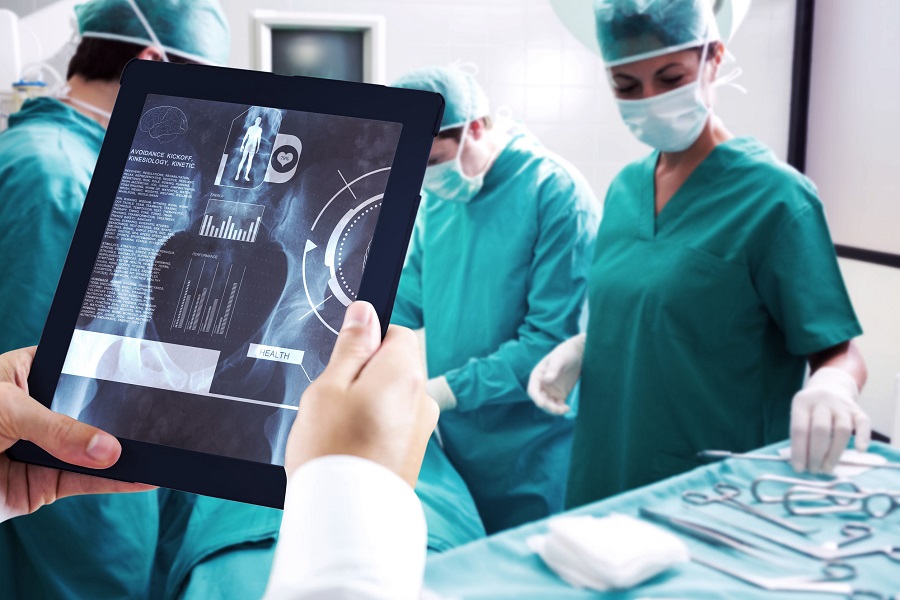
In a recent article in Annals of Surgery, a research team from Massachusetts General Hospital and MIT details the ways in which artificial intelligence (AI) could revolutionize the practice and teaching of surgery—and how patients will benefit with safer surgeries and better outcomes.
MD, MS
The team, which includes Mass General physician-researchers Daniel Hashimoto, MD, MS, and Ozanan Meireles, MD, from the Department of Surgery, encourages surgeons to collaborate with data scientists in the development of new AI applications and to find the most effective ways to integrate these technologies into clinical practice.
For AI, much of its clinical potential lies in its ability to analyze combinations of structured and unstructured data such as EMR notes, vitals, laboratory values and video footage to provide surgeons with significantly improved clinical decision support, the authors say.
While the potential for AI is great, the authors also caution that these technologies will only be as good as the data that is used to power them—and the clinical expertise of the surgeons in implementing them into the operating room (OR).
Machine Learning
Machine learning (ML) is a method of data analysis that identifies underlying patterns and structures to enable a computer to learn and make predictions.
By applying multiple algorithms to the same data set, ML applications could significantly improve on the predictions made by conventional statistical methods, the authors say.
The authors note a recent study in which an ML application significantly outperformed a decision tree approach in predicting lung cancer staging.
The ML application performed at 93% sensitivity (correctly identifying the disease), 92% specificity (correctly identifying those who did not have the disease) and 72% accuracy (the percentage of patients it correctly identified out of the total). By comparison, the decision tree model performed at 53% sensitivity, 89% specificity and 72% accuracy.
Natural Language Processing
Natural language processing (NLP) is a subfield of AI that emphasizes building a computer’s ability to understand human language. The authors say NLP will play a crucial role in analyzing and integrating electronic medical data into AI applications, especially narrative documentation from physicians.
NLP technologies can be trained to extract relevant medical information out of narrative statements provided by physicians in a way that will allow physicians to write more naturally, rather than having to input specific text sequences or select from a menu of options.
Artificial Neural Networks
Much like the brain changes the way it processes information as it responds to external stimuli, artificial neural networks (ANNs) change the pathways used to process information as they develop different input and output maps corresponding to tasks such as pattern recognition and data classification.
A 2016 study demonstrated that by using clinical variables such as patient history, medications, blood pressure and length of stay, ANN algorithms can yield predictions of in-hospital mortality after open abdominal aortic aneurysm repair with a sensitivity of 87%, specificity of 96.1% and accuracy of 95.4%.
Computer Vision
Computer vision describes the ability of a machine to analyze and understand information contained in images and videos.
Utilizing ML approaches, current work in computer vision is focusing on higher level concepts such as image-based analysis of surgical procedures to identify patient cohorts, conduct longitudinal studies and inform decision-making in surgery.
The authors say that computer vision could also be used as a real-time operating assistant to identify and respond to surgical complications and errors.
For example, a recent study found that real-time analysis of laparoscopic video yielded 92.8% accuracy in identifying the steps of a sleeve gastrectomy and was able to note missing or unexpected steps.
The Role of Surgeons
While these use cases are promising, the authors caution that as with any new technology, AI is susceptible to unrealistic expectations that can lead to disappoint and disillusionment.
“It is not a magic bullet that can answer all questions, and it will not improve on all methods of analysis.”
For example, systemic biases in data collection can affect the accuracy of algorithms and could impact the accuracy of prediction models for women and racial minorities due to their under-representation in clinical trials.
“Although the automated nature of these technologies finds patterns missed by humans, scientists are left with little ability to assess how or why such patterns were recognized by the computer.”
The team says that surgeons must work to improve the diversity of patient information in data models, advocate for transparency in AI algorithms, and collaborate with patients to develop the right way to integrate AI technologies into clinical care.
“If appropriately developed and implemented, AI has the potential to revolutionize the way surgery is taught and practiced with the promise of a future optimized for highest quality patient care.”
Learn More
- Surgical Artificial Intelligence Laboratory (SAIL) at Mass General
- TEDx Talk by Daniel Hashimoto, MD, MS
- Watch the PBS News Hour segment
About the Mass General Research Institute
Massachusetts General Hospital is home to the largest hospital-based research program in the United States. Our researchers work side-by-side with physicians to develop innovative new ways to diagnose, treat and prevent disease.
Support our research


Leave a Comment