
The coronavirus pandemic has forced the closure of schools and businesses across the country, and practicing social distancing has thrown many families for a loop.
Public playgrounds have closed and experts have advised against scheduling play dates, leaving many children in their homes for majority of the day. While this may not be an ideal situation, it has some parents getting creative with how to keep their kids entertained with educational activities.
Nitya Jain, PhD, a researcher from the Mucosal Immunology and Biology Research Center at MassGeneral Hospital for Children, has been conducting research for her lab remotely while also caring for two young children at home.
As an avid supporter of STEM, she has been performing small science experiments at home with them every day, and she happily shared a few of them with us.
Check out a few of her experiments below. And be sure to follow Dr. Jain on Twitter for more ideas.
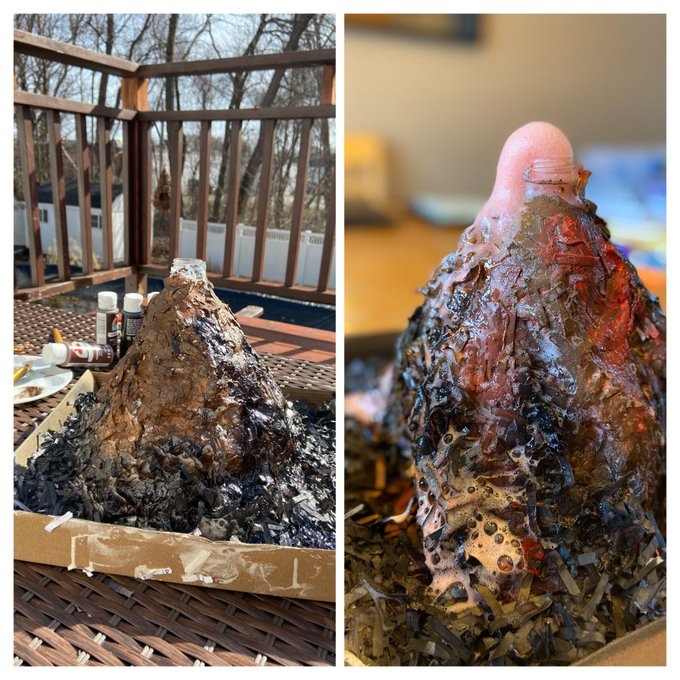
Papier-mâché volcano
What you need:
- Empty 500ml plastic water bottle – 1 (Poland Springs type)
- Newspaper cut into strips (or use the strips from paper shredder waste!)
- Tape
- Scissors
- Paint (acrylic preferred), paint brushes
- All-purpose flour
- Water
- Cardboard box/base large enough to hold your volcano (lids of shoe boxes etc.)
Activity:
- Place empty water bottle in the center of cardboard box.
- Scrunch some newspaper and place it around the bottle.
- Tape the newspaper to the bottle and base to create a ‘frame’ for your volcano.
- Mix one part flour to two parts water in a microwave safe container.
- Microwave at full heat for 30-45 seconds. Remove and stir carefully. Let it cool a little.
- Coat paper strips with flour paste and start applying to the sides of the ‘frame’.
- Keep going until you reach the desired shape.
- Set aside to dry.
- Paint your volcano with acrylic paints.
- Add ½ cup of baking soda to the water bottle (use a funnel!) and then add a few squirts of liquid dish soap.
- Warm 1 cup of vinegar in a microwave safe cup for 15 seconds. Add a few drops of red color to the warm vinegar. Stir.
- Add vinegar to the bottle containing baking soda + soap.
- Watch the ‘explosion’ with some steam added to the effect!
How does it work?
This is a class acid and base reaction. Vinegar, also called acetic acid, reacts with a baking soda (or sodium bicarbonate), a base, to create salt, water and the gas carbon dioxide. The gas makes the soap bubble and this is what you see coming out of the bottle as “lava.”
Let it (diaper) snow!
What you need:
- Diaper (unused)
- Scissors
- Water
- Large bowl to make snow in
Activity:
- Cut out bottom of diaper and carefully remove white, cottony material.
- Add small quantities of water slowly.
- Watch the material become damp and squishy like snow.
How does it work?
The cottony material in the diaper is a polymer called sodium polyacrylate. This polymer has the ability to absorb a lot of water and expand. Another way to do this experiment is to use ‘Insta-snow” from a retailer and use instead of diapers. I think using diapers is way more fun :).
Craft-stick harmonicas
What you need:
- Jumbo craft sticks (2)
- Two smaller rubber bands
- 1 card-stock paper
- Toothpick (cut into 2) or plastic straw cut into 1 inch pieces
- Scissors
Activity:
- Cut a strip of card-stock paper the same size as the craft stick (you can trace the outline of craft stick on paper and cut).
- Place the paper in between two craft sticks. Secure on both ends with the rubber bands.
- Place one toothpick piece between the paper and the rubber band on one end and the other toothpick on the other end. (It works best if you place one toothpick on top of the paper and one toothpick under the paper)
- Blow on the ‘harmonica’ to make a cool sound! Try changing the position of the toothpicks to change the sound.
How does it work?
The card stock paper vibrates between the craft sticks to produce sounds. A thick rubber-band may be used instead of card stock paper to produce a similar effect.
COVID-19 Research at Mass General
Researchers and clinicians at Massachusetts General Hospital Research Institute are mobilizing to develop new strategies to diagnose, treat and prevent COVID-19. Learn more.


Leave a Comment