
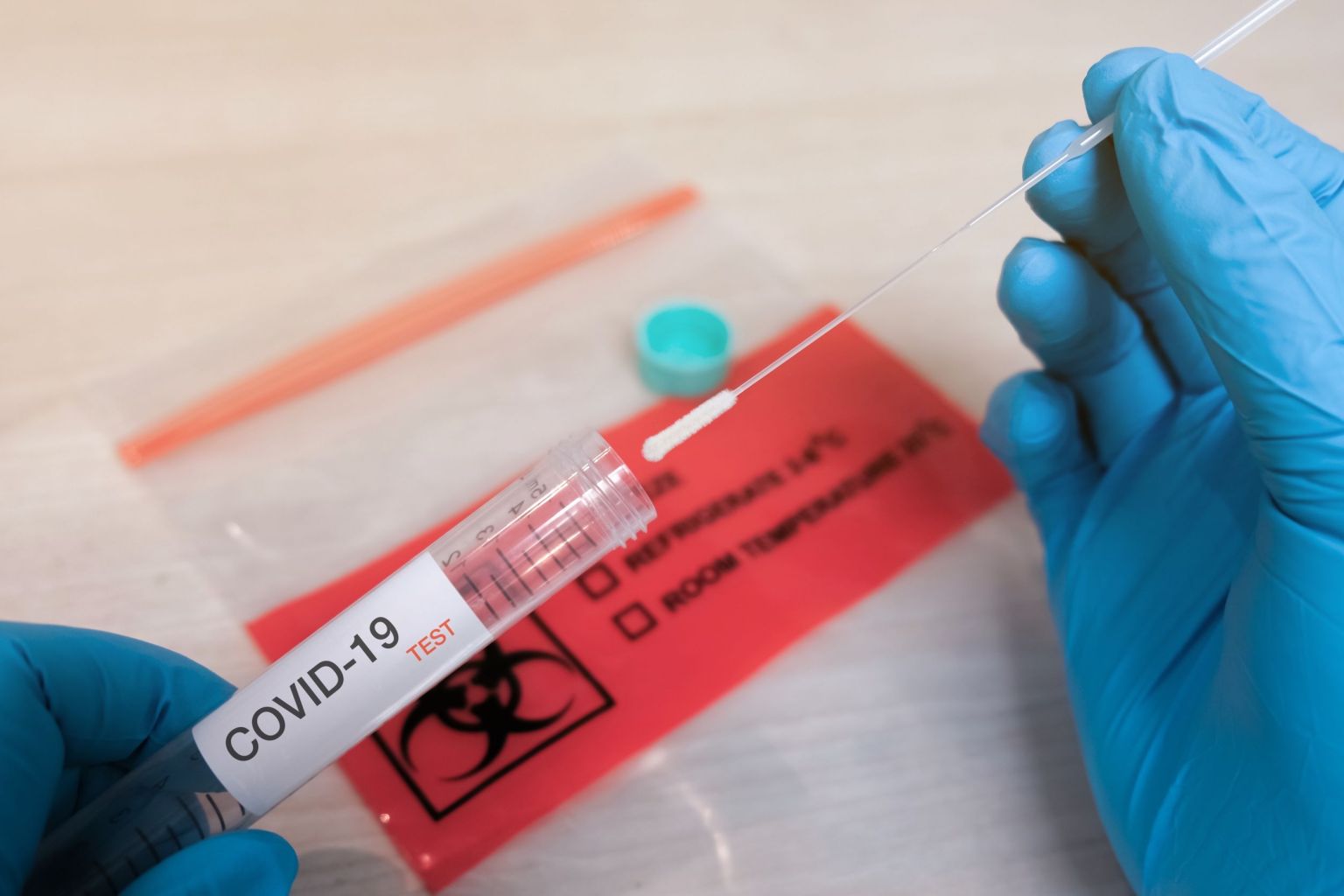
COVID-19 nasal swab test
What will the next generation of COVID-19 tests look like?
In a recent virtual town hall, members of the Mass General Brigham (MGB) Center for COVID Innovation (CCI) outlined the parameters that new diagnostic tools will have to meet:
- A stable supply chain for the materials used to conduct the test
- An extremely high level of accuracy to reduce potential errors and the need for multiple tests
- Fast turnaround times for results–three hours at the most, ideally in an hour or less
- A limited number of manual steps to improve scalability
- Results that are easy for patients to understand
Nasal Swab Limitations
To kick off the discussion, Michael Klompas, MD, an infectious disease physician and epidemiologist from Brigham and Women’s Hospital (BWH), shared the limitations of the current COVID-19 testing method—taking a sample of the patient’s respiratory track with nasal pharyngeal swab that is analyzed using polymerase chain reaction (PCR) technology.
A key limitation of this test is that it not very sensitive—meaning it does not always detect a true positive case—particularly in the earlier stages of the disease. This means that both confirming and ruling out illness often requires multiple tests. “It’s both inefficient and leaves room for error,” says Klompas.
The limited sensitivity issue is important as it could result in a person with COVID-19 being discharged without proper precautions, which could put other people and facilities at risk.
“That’s deeply concerning as we think about infection control. It’s also deeply concerning as we think about containment in another phase if we were to be revisiting this disease in the fall,” says Rochelle Walensky, MD, MPH, chief of the Mass General Division of Infectious Diseases and Steve and Deborah Gorlin MGH Research Scholar 2015-2020.
Another limitation of the swab and PCR method of testing is the turnaround time. When the rise in COVID-19 cases began, tests had to be sent to the state lab and the turnaround time was five to seven days.
Now that testing is being conducted in-house turnaround times range between six and 24 hours. But there are some platforms that can provide results within 45 minutes. Since any delay can increase the risk of exposure—the faster results come back, the better.
Developing New Diagnostics
Diagnostics experts are adapting to the rapidly changing situation as swiftly as possible, and part of that means developing new tests in response to ever changing resources and clinical needs.
Neal Lindeman, MD, a pathologist and director of Molecular Genetics at BWH, said new tests are being designed, validated and deployed at the hospital faster than he’s ever seen.
“We’ve developed over 40 tests in the 20 years I’ve been here and typically it’s a process that takes nine months. We’re now doing that in about three days,” he explains. In the two weeks leading up to the April 1 town hall discussion, he and his colleagues had already developed, validated and implemented three different diagnostic tests.
A key challenge HAS establishing a steady supply chain—vital test components would be in tremendous supply one day and completely sold out the next.
“We’re frequently finding ourselves in the lab, having to pivot and maybe even maintain more than one method at a time, which is not the way we’re used to doing things,” says Lindeman.
Sensitivity vs. Specificity
Another key challenge is developing a diagnostic that is both highly sensitive and highly specific. In the lab setting, a test’s sensitivity is a measure of how well it is able to produce a true positive result, while specificity is its ability to produce a true negative result—i.e. not missing any positive tests.
Ideally, the test would be both sensitive and specific, but striking the right balance can be difficult. “Is your ultra-sensitive test picking up a signal that’s too low for the other methods? Or are you picking up assay noise or false positives? It becomes extremely difficult to prove,” Lindeman explains.
John Iafrate, MD, a Mass General pathologist, also notes that combining test speed and sensitivity may not always be possible, particularly when it comes to the smaller, faster point-of-care tests now being explored. PCR testing appears to be the most sensitive option to date, he said.
“If we move to anything else, even if it’s easy and fast, we risk not being sensitive and missing some patients.”
Iafrate and colleagues at the Ragon Institute of MGH, MIT, and Harvard are increasing testing options by exploring antibody tests as well. Antibody testing could allow scientists to detect whether an individual has been exposed to the virus and gauge whether it would be safe for them to return to the workforce. Using blood samples, experts may also be able to test whether serum treatments could be effective for patients with severe COVID-19.
Moving Forward
To tackle these different needs, David Walt, PhD, BWH pathologist and CCI co-director, shared a plan to create several working groups that address key needs:
- Logistics, critical materials and capacity building: to streamline operations, increase efficiency and improve lab turnaround times
- Point-of-service testing: to devise new ways for healthcare workers to test and receive results on site
- Direct to consumer testing: to create opportunities for self-testing at home
- Diagnostics accelerator: to speed the process of developing and evaluating new diagnostic technologies
- Validation: to set the specifications, performance criteria and assess technologies before deployment
Over 600 participants joined the diagnostics town hall, and Walt noted the number of volunteers has been remarkable.
“There are a tremendous number of people who are interested in contributing and helping to this effort in a very selfless manner,” Walt said. “People are just offering to do things they’re not doing their research, but they want to get involved in something.”
“It was an outstanding discussion,” says Remondi Family Endowed MGH Research Institute Chair and CCI co-director Gary Tearney, MD, PhD.
“The quality of the people in this community is far to none. And so, if anybody’s going to get to it and solve this problem, I think it’s going to be us. Let’s get to work to really help our patients and our health care givers on the front lines.”
COVID-19 Research at Mass General
Researchers and clinicians at Massachusetts General Hospital Research Institute are mobilizing to develop new strategies to diagnose, treat and prevent COVID-19. Learn more.


Leave a Comment