
We’ve already covered some of Dr. Jain’s experiments on our blog here. Check out a few more of her experiments below, and be sure to follow Dr. Jain on Twitter for more ideas.
They say necessity is the mother of invention, and in the search for educational activities to keep kids occupied, one mother and Mass General researcher has been getting particularly creative.
Nitya Jain, PhD, a researcher from the Mucosal Immunology and Biology Research Center at MassGeneral Hospital for Children, has been conducting research for her lab remotely while also caring for two young children at home.
As an avid supporter of STEM, she has been performing small science experiments at home with them every day. Here is her next batch of science experiments for kids.
Homemade Thermometers
What you need:
- Modeling clay or playdough
- Red food coloring
- Water
- Clear straw
- Rubbing alcohol
- Small (500ml) empty plastic water bottle (clear)
Activity:
Pour 50ml (or 1/4 cup) of tap water and 100ml (or 1/2 cup) of rubbing alcohol into the bottle until it’s a quarter full.
- Add a few drops of red food coloring, and shake the bottle to mix it.
- Insert the straw into the bottle, not letting it sink to the bottom.
- Secure straw to the opening of the bottle with playdough /clay. Let part of the straw stick out of the bottle. The clay should be tight around the straw and cover the bottle mouth. Leave the top opening of the straw uncovered.
- Warm the bottle: Either wrap your hands around the bottom or place setup in a sunny/warm area. Watch the liquid in the bottle climb up the straw!
How does it work?
When the alcohol and water mixture gets hot, the mixture expands and the only place for it to go is up the straw.
Homemade Balloon Pump
What you need:
- Latex balloon (medium size)
- Vinegar
- Baking soda
- Small (500ml) empty plastic water bottle
- Funnel
Activity:
- Add 1/3 cup of baking soda into the balloon using a funnel (if you don’t have a funnel, fold a piece of paper into a cone shape and use as funnel!).
- Add 1 cup of vinegar to the bottle.
- Carefully secure the neck of the balloon onto the neck of the bottle without letting any baking soda fall in to the bottle.
- Now lift the balloon up so the baking soda falls into the bottle.
- Watch as the balloon fills up with air!
How does it work?
The baking soda (base) and the vinegar (acid) react to create carbon dioxide (a gas) that fills the bottle and then inflates the balloon.
Bouncing Eggs
What you need:
- 1 egg
- Vinegar
- Tall clear cup or glass
Activity:
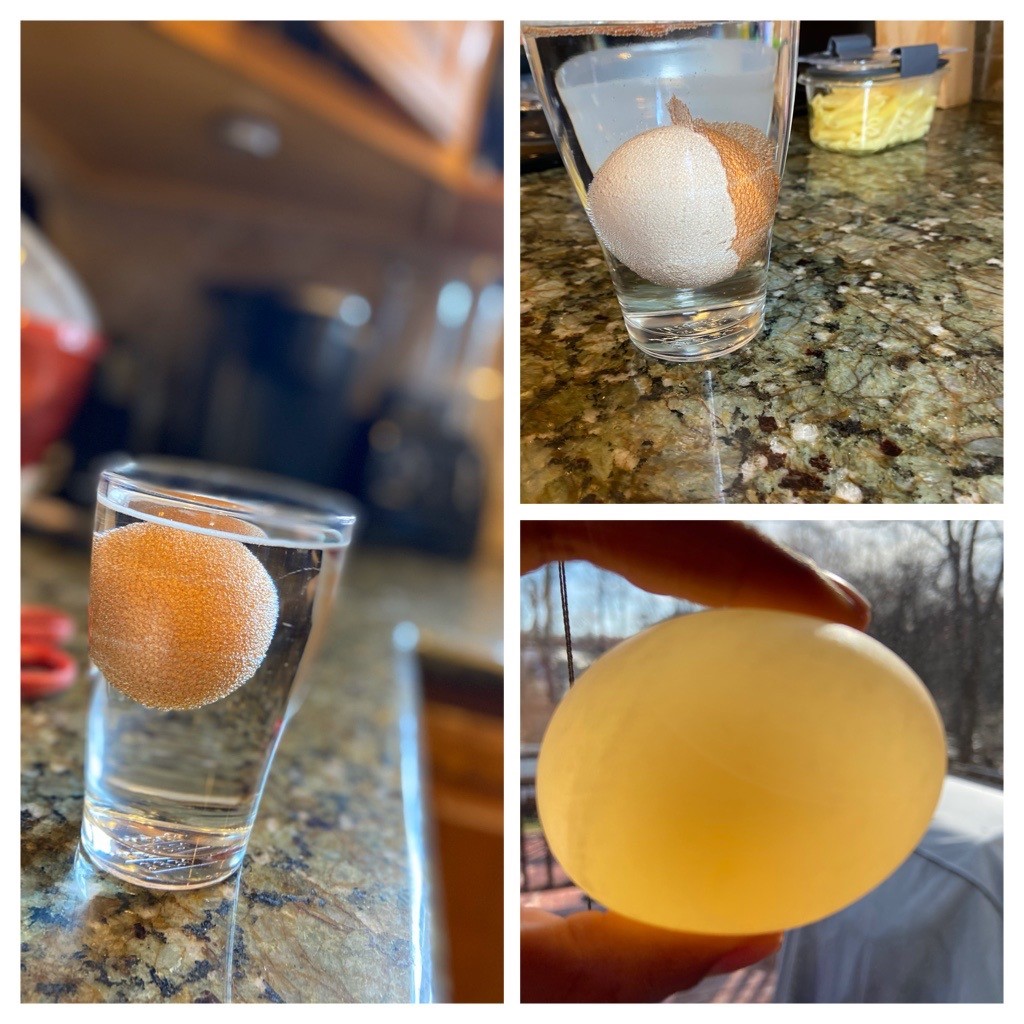
- Place egg in an empty cup and cover with vinegar.
- Observe tiny bubbles begin to surround the egg. Leave for 24 hours.
- Change the vinegar on the second day. Carefully pour the old vinegar down the drain and cover the egg with fresh vinegar. Leave setup undisturbed for 7 days.
- One week later, pour off the vinegar and rinse the egg with water. The egg looks translucent because the shell is gone! The only thing that remains is the thin membrane of the egg surrounding the white and the yolk.
How does it work?
The acetic acid in the vinegar dissolves the egg shell (which contains calcium carbonate) to make the gas carbon dioxide which you see on the egg on the first day. Once the egg shell is completely dissolved by the vinegar, you are left with a thin membrane that holds the yolk and the egg white together. This results in a rather bouncy egg held together by the transparent rubbery membrane.
COVID-19 Research at Mass General
Researchers and clinicians at Massachusetts General Hospital Research Institute are mobilizing to develop new strategies to diagnose, treat and prevent COVID-19. Learn more.


Leave a Comment