
Brian Strickland, MD, a fellow in the Division of Wilderness Medicine at Massachusetts General Hospital, expected to spend the first few months of 2020 finding innovative ways to take care of patients in acute respiratory distress. But he thought it would be in a remote mountainside setting in the Himalayas—not back in Boston at Massachusetts General Hospital.
While the setting may have changed, the principles of wilderness medicine — providing lifesaving care in a remote, austere environment with limited resources — still apply.
Strickland was going to Nepal to conduct research examining continuous positive airway pressure (CPAP) treatment for high altitude pulmonary edema (HAPE), but after traveling halfway across the world and lugging his equipment up a mountain, he was recalled to Mass General to help in treating patients with similar life-threatening respiratory issues due to COVID-19.
Instead of using CPAP machine for high altitude pulmonary edema, he is helping lead research studies to test nitric oxide as a treatment for ARDS.
HAPE and COVID-19
HAPE is a form of pulmonary edema—a buildup of fluid in the lungs–that occurs almost exclusively in the backcountry when individuals ascend a peak too quickly, says Strickland, and if left untreated can be fatal.
Scientists believe that when a person rapidly ascends a high-altitude peak like Mount Everest, blood vessels in the lungs constrict and cause an increase in pressure. The increase in pressure leads to fluid buildup in the lungs and low oxygen levels, which can cause symptoms such as shortness of breath, rapid breathing, cough and fatigue. To date, there is no definitive treatment for HAPE other than descent from high-altitude.
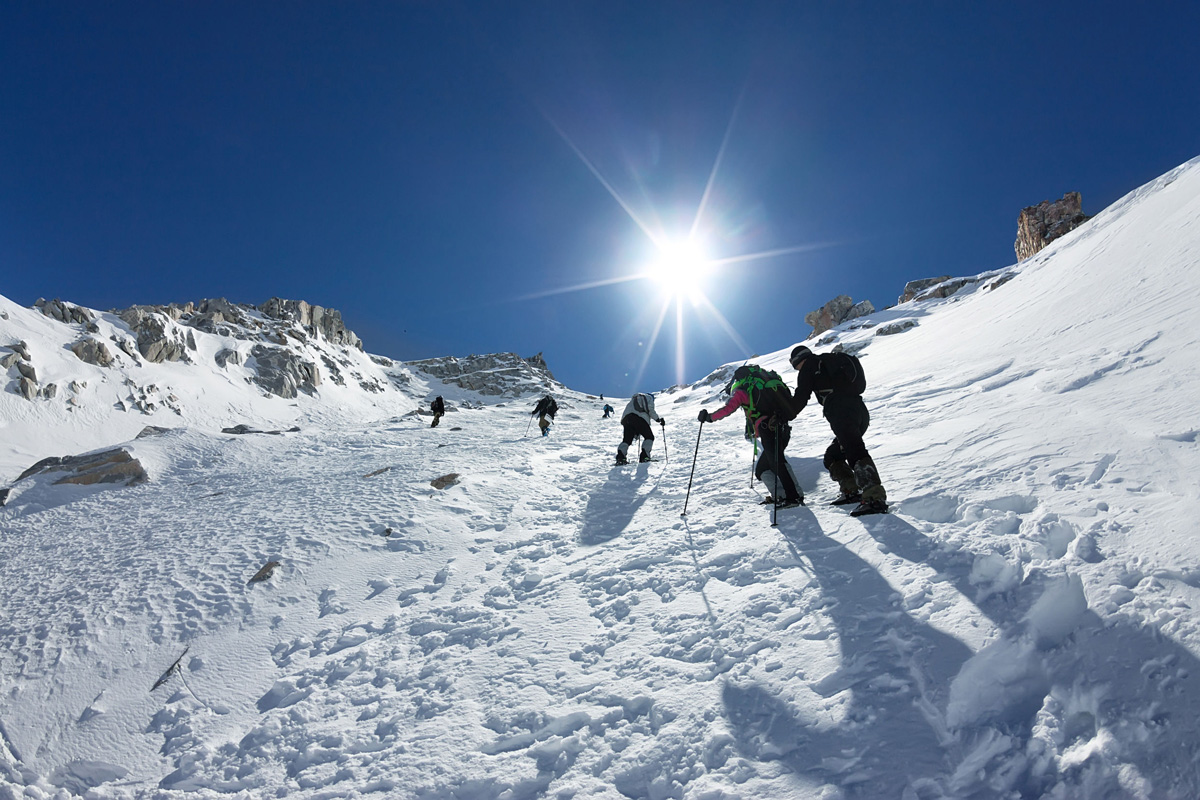
When Strickland left for Nepal to work for the Himalayan Rescue Association, his plan was to conduct one of the first randomized control trials to test whether continuous positive airway pressure (CPAP) could be used to stop the progression of HAPE.
“There’s never been a randomized control trial using CPAP for HAPE because, as an illness that usually occurs in the backcountry, the equipment is not typically available,” says Strickland. To overcome this barrier, he brought a portable, battery-powered CPAP machine that could be used in settings without electricity. “What I was hoping to do with my research project in Nepal was to find a creative solution for a complex problem in very resource-limited situations,” says Strickland, “and applying a portable version of this technology is a way in which we could do that.”
However, when the COVID-19 outbreak began in Boston, he paused his work in Nepal and returned home to lend a hand to his colleagues at Mass General. Upon his return he found patients with severe cases of COVID-19 presenting with symptoms similar to HAPE — such as shortness of breath and fluid in the lungs — due to a condition called acute respiratory distress syndrome (ARDS).
Continuing Research Efforts
While Dr. Strickland may not be able to continue his research in Nepal at the moment, he has been able to transition to a leading research role exploring new treatments for COVID-19.
Clinicians at Mass General have been exploring the use of inhaled nitric oxide as a treatment for ARDS in severe cases of COVID-19. Inhaled nitric oxide works by promoting pulmonary vasodilation – expanding of the blood vessels in the lungs – which can help relieve pressure and raise oxygen levels. It is also thought to be virucidal – directly killing the virus that causes this illness.
Nitric oxide has been used in the past for HAPE for similar reasons, says Strickland, but it has yet to be studied in patients with respiratory distress related to COVID-19. Patients have been recruited to participate and follow-ups are scheduled to occur 28 days after treatment to gather information on outcomes. The research team recently evaluated the first group of follow-ups and results seem promising, but further study is needed.
“When I first returned, COVID was a completely unknown disease. We were very much still learning, and still are learning, about the best care to provide in a resource-limited setting,” says Strickland. “We havevery skilled practitioners here working together to come up with creative solutions for how we can improve health care and improve outcomes for our patients, so in that sense there was a lot of overlap between what I was doing in Nepal and what we are doing at MGH.”
“I think that many of the lessons that we learn in wilderness medicine carry over in situations like these.”
Brian Strickland, MD
COVID-19 Research at Mass General
Researchers and clinicians at Massachusetts General Hospital Research Institute are mobilizing to develop new strategies to diagnose, treat and prevent COVID-19. Learn more.


I’m glad to hear of the nitric work. Months ago I commented here on looking in to nitric as a treatment as I remembered working in the NICU where a study was being done on nitric and newborns on vents in the early 90s. I’m sure I wasn’t the first to think of it, but glad it is being studied!