
We wanted to share some recent Mass General research that has been published in high impact, top-tier journals. This is just a small snapshot of the incredible research that takes place at Mass General each day — there’s lots more to find at massgeneral.org/research/news!
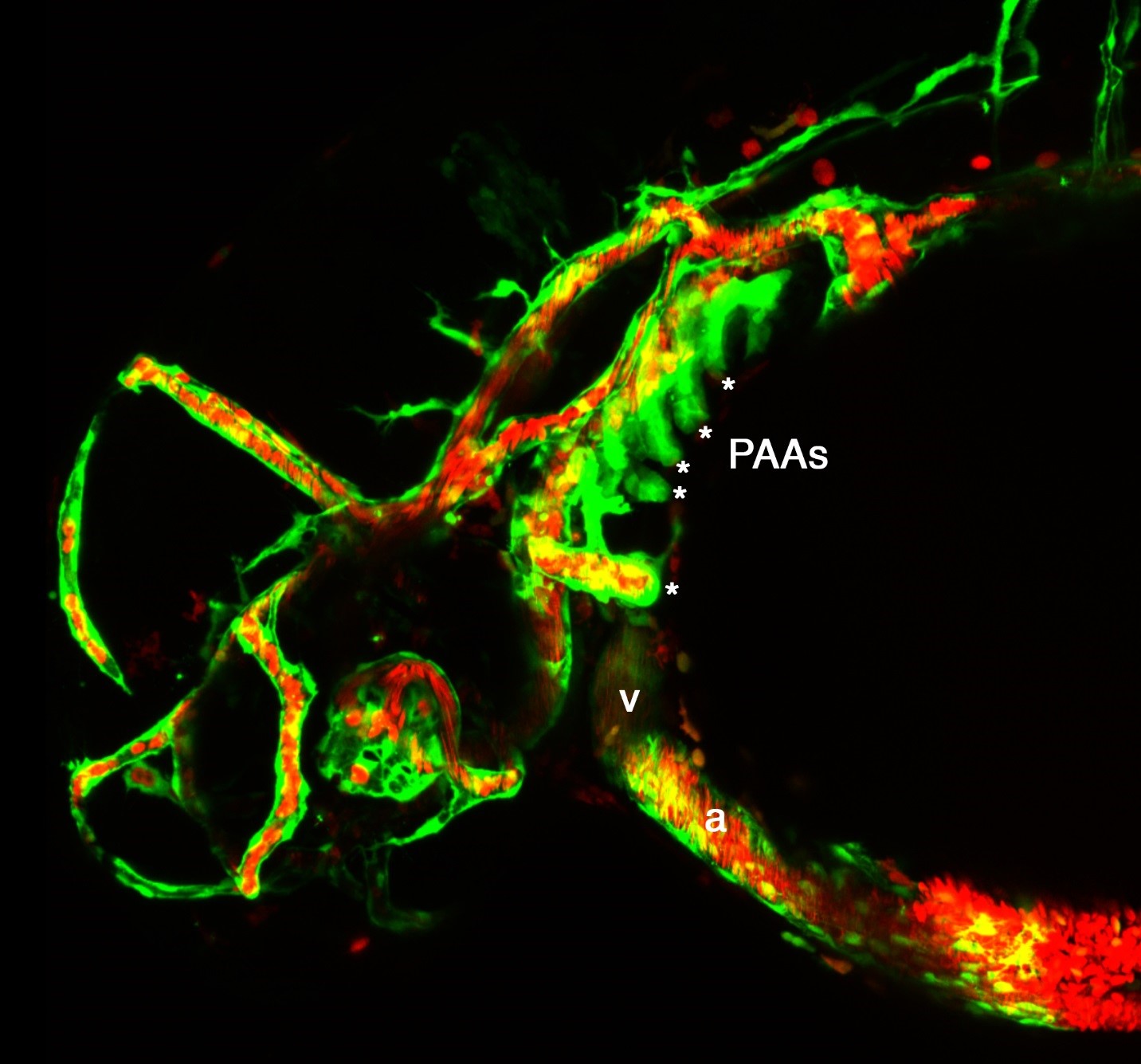
Exploring the Formation of the Aorta in Zebrafish
Summary submitted by Caroline Burns, PhD, d’Arbeloff MGH Research Scholar, and Geoff Burns, PhD, both researchers in the Cardiovascular Research Center at Mass General, and co-senior authors of the study
The aorta and its branches are large arteries in the human body that carry oxygen-rich blood from the heart to the rest of the circulatory system. Structural malformations of the aorta are common birth defects that even in the mildest cases require life-saving surgery at birth.
During fetal life, the aorta is built from transient blood vessels termed the pharyngeal arch arteries (PAAs). However, the mechanisms regulating formation of the PAAs remain poorly understood.
This paper reports that TGFb signaling, a molecular pathway that controls cellular proliferation and differentiation in other contexts, initiates and is essential for PAA development in zebrafish.
Despite this important advance, further research is needed to identify additional molecular pathways that control PAA establishment and to learn if mutations that affect TGFb signaling in humans result in similar aortic deficiencies.
This information can be leveraged to develop new therapies for preventing or treating congenital malformations that involve the aorta and its branches.
Managing Consciousness with Anesthesia Drugs
Summary submitted by Patrick Purdon, PhD, from the Department of Anesthesia, Critical Care, and Pain Medicine, at Mass General, and senior author of the study
This study finds evidence that propofol, an anesthetic drug frequently used in clinical practice, disrupts activity in the parts of the brain responsible for awareness and coordination by inducing highly synchronized oscillations within and between these brain structures.
The study also found that during recovery of consciousness, these synchronized oscillations dissipate in a distinct “boot-up” sequence, one that did not simply mirror loss of consciousness.
This implies that recovering consciousness is not just a passive process, but an active one involving a different set of brain areas responsible for “waking up” the brain.
Overall, this study advances understanding of what it means to be unconscious under anesthesia, and establishes principled neurophysiological markers to monitor and manage this state.
Impact of Genetic Disease on Metabolism and Exercise
Summary submitted by Rohit Sharma, PhD, from the Department of Molecular Biology at Mass General, and co-investigator of the study
Human metabolism is “wired” to allow us to go from rest to running by efficiently burning sugars, fats and proteins to harness their energy.
However, patients with certain genetic conditions like McArdle disease who cannot access glycogen stores or mitochondrial disease who have broken respiratory chains have symptoms that are exacerbated by exercise.
Scientists from the Mootha lab studied the exercise-induced changes that occur in hundreds of plasma metabolites in healthy individuals, patients who have McArdle disease and mitochondrial disease patients.
By comparing these disorders they shed light on the typical metabolic processes that allow us to exercise and also revealed potential disease biomarkers.
Treating Blood Vessel Inflammation Without Steroids
Summary submitted by John Stone, MD, MPH, Director of the Clinical Rheumatology in the Rheumatology Unit at Mass General, and lead author of the study
Giant cell arteritis (GCA) is the most common form of blood-vessel inflammation. Complications include blindness and aneurysm. Up to now, the only known effective treatment was a steroid called prednisone which caused many complications.
Now a phase 3 clinical trial has confirmed for the first time in the history of this disease that regular treatment with a drug called tocilizumab successfully reduces the need for high-dose steroid treatment.
Patients who received tocilizumab plus a prednisone taper were nearly four times more likely to achieve disease remissions compared to those who received prednisone alone.
Results of the trial were the basis for the Food and Drug Administration’s approval of tocilizumab to treat GCA in May 2017.
About the Mass General Research Institute
Massachusetts General Hospital is home to the largest hospital-based research program in the United States. Our researchers work side-by-side with physicians to develop innovative new ways to diagnose, treat and prevent disease.
Support our research


Leave a Comment