
In a case of mistaken identity, researchers at Massachusetts General Hospital have found that lymph nodes are not always responsible for cancer’s deadly progression to other organs.
These results buck many preconceived notions about lymph nodes’ role in cancer development and suggest a new pattern for the progression of certain types of cancer.
Doctors recognize that patients whose cancer spreads (metastasizes) from the original tumor to the surrounding lymph nodes have a worse prognosis than patients whose lymph nodes are cancer-free.
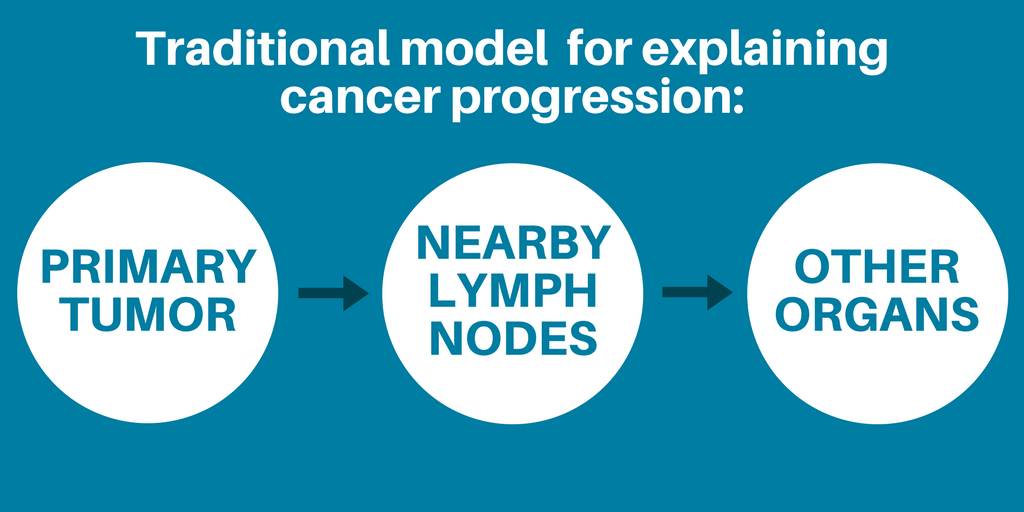
This observation has traditionally been explained by a progression model of primary tumor to nearby lymph nodes to other organs. However, no conclusive evidence for this model has existed so far.
Digging Deeper into Cancer’s “Family Tree”
In a new study, researchers from the Edwin L. Steele Laboratories for Tumor Biology in the Mass General Department of Radiation Oncology investigated the “family tree” of metastases in colorectal cancer.
Contrary to the prevailing belief that the spread begins in the lymph nodes, they found that the cancer could spread to both the lymph nodes and the organs simultaneously.
In their report in the July 7 issue of Science, the researchers describe finding that, for the majority of colorectal cancer patients in the study, organ metastases (also called distant metastases) originated directly from the primary tumor, independent of any lymph node metastases.
A Sign of Aggression, Not Progression
“We now suspect that lymph node metastases simply indicate the presence of an aggressive primary tumor, rather than being directly responsible for the formation of distant metastases,” says lead and corresponding author Kamila Naxerova, PhD, Research Fellow at the Steele Labs.
The researchers analyzed more than 200 tissue samples of primary tumors, lymph node metastases and distant metastases from 17 patients with colorectal cancer.
Samples from 35 percent of these patients followed the traditional progression model. In these samples, both lymph node and distant metastases came from the same cell type in the primary tumor, indicating that the cancer had spread from the primary tumor to the lymph nodes and then to other organs.
However, in 65 percent of patients, researchers found that cell types in lymph node and distant metastases were different and matched different cell types within the primary tumor, indicating independent origins for these metastasis types.
Their results suggest that although cancer progression can follow the traditional model described above, there is also a second distinct pattern of metastatic spread.
“These findings fill an important gap in our knowledge of metastatic disease evolution and have the potential to guide improvements in the clinical management of lymph node metastases,” says Naxerova.
The research team is now following up with a larger cohort of patients to confirm whether survival differences exist between patients with a traditional progression pattern vs. the second progression pattern.
Rakesh K. Jain, PhD, Director of the Steele Labs, was senior author of this paper.
About the Mass General Research Institute
Massachusetts General Hospital is home to the largest hospital-based research program in the United States. Our researchers work side-by-side with physicians to develop innovative new ways to diagnose, treat and prevent disease.
Support our research


Well really an interesting finding, since conventional wisdom would suggest, perhaps even without previous data on the subject, that the lymphatic system would have to be the primary vehicle in delivering these cells.
I would like to see some sort of bio-marker able to seat itself on the cancer cell’s pathways (kinda like a “hitch hiker”,) then we would truly be able to pin point all of the pathways and eliminate the guessing.