
Science news and discoveries from the Mass General Research Institute
Bench PressBench PressBench PressBench Press
  • Home
  • About
  • Research
    • COVID-19
    • Brain
    • Heart
    • Cancer
    • More…
  • Communicating Science
  • Events
  • Subscribe

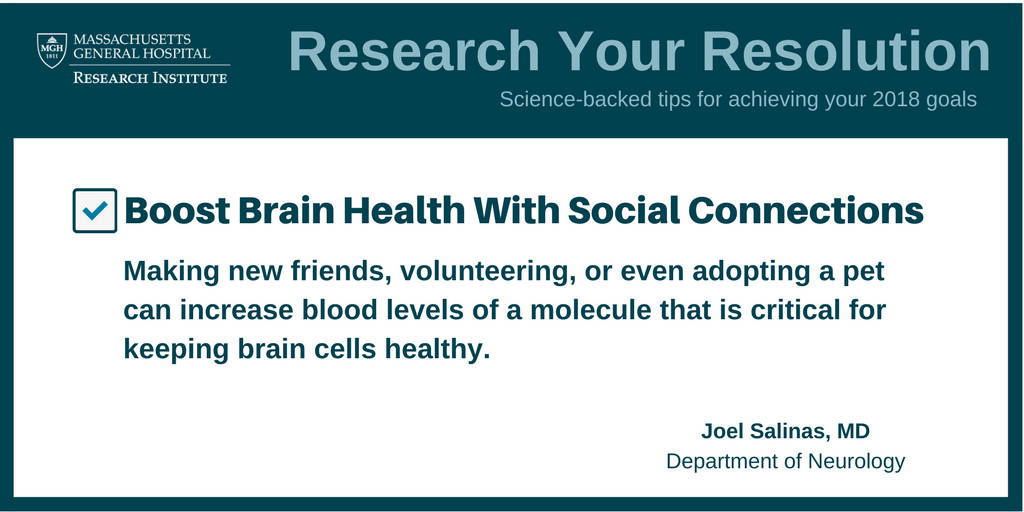
Research Your Resolution: Boost Your Brain Health With Social Connections

By mghresearch | Alzheimer's Disease, Neurology | 0 comment | 12 January, 2018 | 0
Joel Salinas, MD
Joel Salinas, MD

Joel Salinas, MD, is a behavioral neurologist, neuropsychiatrist, and social epidemiologist at the Massachusetts General Hospital Institute for Brain Health. To learn more about his research, please visit his lab website.


When we make social connections with other people, we live better and have healthier brains for longer.

This might mean re-connecting with old friends, making new friends, joining a group or a class, teaching someone something new, volunteering or offering to help others, or using technology to keep in touch, getting a pet, or simply sharing a smile.

Studying over 3,000 members of the Framingham, MA, community since 1948, and across multiple generations, we found that people who are the most socially isolated have lower blood levels of a molecule known as brain-derived neurotrophic factor (or BDNF) which is critical for keeping brain cells healthy and forming new connections between cells.

However, people who have someone available to listen to them or receive emotional support from someone else most or all of the time not only seem to have increased levels of BDNF, but they also have a lower risk of developing stroke and dementia.

There is no cure yet for many age-related brain diseases, but there is a cure for social isolation.

By addressing what we can change in our life to reduce our risk for brain disease, there may be a way to delay and eventually prevent these diseases and prolong the span of our brain health.


Research Your Resolution

Do you have goals for improving your health in the New Year? This month, investigators from the Mass General Research Institute are discussing the science behind some common New Year’s resolutions, and offering tips and advice based on their research into exercise, diet, healthy aging, heart health, and much more. See more posts in the series.

Massachusetts General Hospital is home to the largest hospital-based research program in the United States, a community of more than 10,000 people working across 30 departments, centers and institutes. The Mass General Research Institute works to support, guide and promote these research initiatives.

About the Mass General Research Institute
Massachusetts General Hospital is home to the largest hospital-based research program in the United States. Our researchers work side-by-side with physicians to develop innovative new ways to diagnose, treat and prevent disease.
Support our research

aging, dementia

Related Post

  • Jennifer Gatchel studying Alzheimer's disease

    12 Days of Research at Mass General: Untangling the Connections Between Alzheimer’s Disease and Mental Illness

    By mghresearch | 0 comment

    In the 12 days leading up to our holiday hiatus, we are looking back on the past year and sharing some highlights in Massachusetts General Hospital research news from each month of 2017.

  • mitochondria

    Too Much of a Good Thing? How a Typically Healthy Cellular Process Turns Harmful

    By mghresearch | 0 comment

    Mass General researchers have made a key discovery about how the cellular process of autophagy can extend or shorten lifespan.

  • The IBHCRP: Breaking Down the Walls that Separate Physical and Mental Health

    By gir0 | 1 comment

    What if there was a simple way to help individuals prioritize their emotional health just as much as their physical health?

  • Research Your Resolution: Focus on Your Mental Health, Especially As You Age

    By mghresearch | 0 comment

    While the number of individuals with dementia worldwide is on the rise as populations age, data are encouraging that a fraction of dementias may be preventable and that lifestyle interventions may have the potential to modify the course of changes in memory and thinking with aging¹.

  • Jennifer Gatchel studying Alzheimer's disease

    Gatchel Untangles the Causes of Mood and Anxiety Symptoms and Loss of Brain Function in Aging Populations

    By mghresearch | 4 comments

    Mass General geriatric psychiatrist Jennifer Gatchel MD, PhD, is working to unravel the connections between mental illness and the onset of Alzheimer’s disease.

Leave a Comment

Cancel reply

Your email address will not be published. Required fields are marked *

Categories

Social

Tags

adolescents aging allergies ALS artificial intelligence brain health cancer treatments child health cholera clinical research clinical trials community health coronavirus dementia diagnostic tools diversity exercise Harvard health disparities heart attacks heart disease heart failure heart month hypertension image contest innovation internships kidney disease machine learning martinos center memory mental health microbiome Munn Center for Nursing Research nursing PET imaging postdocs public health Ragon Institute rare diseases researchers science writing sleep women's health women in medicine

Copyright 2020
Mass General Research Institute
All Rights Reserved

SUBSCRIBE TO BENCH PRESS


Contact

Mass General Research Institute
125 Nashua St.
Boston, MA 02114
617-724-0200
researchinstitute@mgh.harvard.edu
M-F: 9:00 am - 5:00 pm
  • Home
  • About
  • Research
    • Brain
    • Cancer
    • Heart
  • Communicating Science
  • Events
  • Home
  • About
  • Research
    • Brain
    • Cancer
    • Heart
    • More…
  • Communicating Science
  • Events
Bench Press