
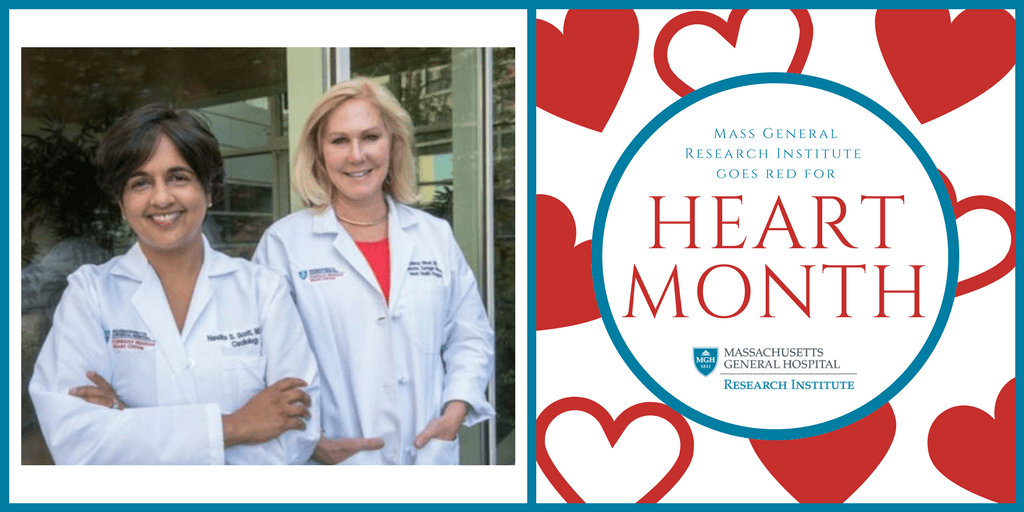
(above) Nandita Scott, MD (left), and Malissa Wood, MD, co-directors of the Corrigan Women’s Heart Health Program
Cardiovascular disease — including heart attacks, stroke and heart failure — is the number one killer of adults, but more women die of it than men. The Elizabeth Anne and Karen Barlow Corrigan Women’s Heart Health Program was launched in 2007 to focus awareness, treatments and research on the unique issues women face in maintaining heart health. It was established through a gift from Jerry Corrigan and Cathy Minehan. Program co-directors Malissa Wood, MD, and Nandita Scott, MD, discuss what they’ve learned over the past ten years and the challenges ahead.
What led you to specialize in cardiology?
Dr. Scott: I went into cardiology because it’s one of those fields where you can make a big difference in people’s lives. There are great diagnostic and treatment tools.
Dr. Wood: The biggest fascination for me was the recognition that cardiovascular disease is the number one killer. I trained a decade before Nandita, when new treatments were emerging. I wanted to use my talents to apply those techniques to help patients have better outcomes.
Why is there a need for a heart health program for women?
Dr. Wood: Cardiovascular disease is underdiagnosed in women. To close the big gaps in care, we wanted to pull together people who understand the pathophysiology of the heart of women, which is quite different than a man’s. Women’s hearts and arteries are smaller, for example. Symptoms of a heart attack can be different for a woman. Another difference is that blockages in smaller blood vessels as opposed to larger arteries are more often the cause of chest pain or angina in women. Our program seeks to tailor therapy and research to women.
When in life should women be most concerned about heart health?
Dr. Wood: All through life. We see patients from age 18 to 100.
Dr. Scott: There are dramatic changes in the cardiovascular system during pregnancy, for example. Blood volume increases and the heart is required to work harder. Pregnancy is like a stress test, a window into future heart health. Those who develop preeclampsia [a potentially dangerous condition that causes high blood pressure] have increased risk of future cardiovascular disease. We formed the Pregnancy and Heart Disease Program to address the needs of women with preexisting heart disease and who develop heart disease during pregnancy.
Dr. Wood: Cardiovascular disease is a major cause of death for women after they give birth. Maternal mortality is worse in the United States than other developed countries and we need to address that.
Your program is now the go-to for young women who have a heart attack due to spontaneous coronary artery dissection, or SCAD, a tear in the artery wall that blocks blood flow. What have you learned about it?
Dr. Wood: It used to be considered rare but that’s because it was underdiagnosed. Because so many are referred here, we have a large register of SCAD patients we are studying. Over 90 percent of them are thin, fit and athletic. Mark Lindsay, MD, PhD, looked at genetic differences and found that only 9 percent have a genetic abnormality. We are also finding that the cumulative effects of stress can trigger a SCAD-related heart attack in women, whereas men were more likely to have a heart attack while exercising. Reducing stress in our lives is extremely important for all women.
Women fear breast cancer but isn’t heart disease more likely?
Dr. Scott: One in ten women gets breast cancer and at least one in three women develops some form of cardiovascular disease. In women, it causes more deaths each year than the next two causes combined — cancer and chronic lower respiratory disease.
Besides exercise and a healthy diet, what should women do to maintain heart health?
Dr. Wood: We found some answers to that question in our Happy Heart study at the MGH Revere HealthCare Center. Lifestyle changes reduced blood pressure, weight and cholesterol, all of which change unfavorably after menopause. We found, too, that chronic stress is a significant risk factor for women and that mind-body therapies can reduce risk. Heart disease is preventable.
What challenges does the program face over the next ten years?
Dr. Scott: We would love to have more staff to accommodate all the women who want to be seen. Seven years ago, Maria Vivaldi, MD, joined us and has a thriving practice at the Revere clinic, helping women who often need us the most. Heart disease in women is now getting more attention; however, there are still many unanswered questions that we would like to research further.
This article originally appeared on the Massachusetts General Hospital Giving website.
About the Mass General Research Institute
Massachusetts General Hospital is home to the largest hospital-based research program in the United States. Our researchers work side-by-side with physicians to develop innovative new ways to diagnose, treat and prevent disease.
Support our research


Leave a Comment