
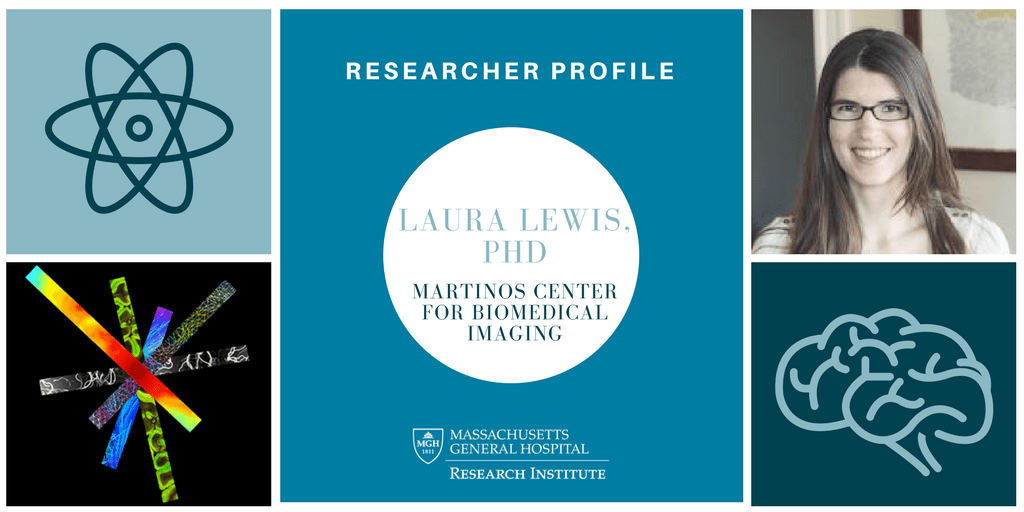
The Society for Neuroscience recently named Mass General researcher Laura Lewis, PhD, a recipient of the Peter and Patricia Gruber International Research Award. Supported by The Gruber Foundation, the award recognizes young neuroscientists for outstanding research and educational pursuit in an international setting and includes $25,000 for each recipient.
We asked Dr. Lewis, an investigator at the MGH Martinos Center for Biomedical Imaging and a junior fellow in the Harvard Society of Fellows, about her research and how this award will help advance her work.
What problem(s) are you addressing with your research?
My goal is to understand what happens in the brain during sleep and anesthesia. Sleep is essential for healthy brain function, but we still know surprisingly little about how it works.
Why do we become unconscious during sleep, and how is this different from losing consciousness during anesthesia? Why do we dream and why is our cognition impaired when we haven’t slept enough?
Ultimately, we’d like to answer these questions by studying the human brain.
However, noninvasively measuring human brain activity is very challenging, so I also work on developing new techniques for imaging and analyzing brain function.
What methods are you using?
I use a combination of methods. Most recently, I’ve been working on developing noninvasive imaging approaches that combine functional magnetic resonance imaging (fMRI) and electroencephalography (EEG) to measure human brain activity at high resolution.
I’m collaborating with physicists and engineers to translate new, accelerated imaging methods into use for neuroscience. With these methods, we can scan people as they fall asleep inside the MRI and image small brain regions during sleep.
I also use intracranial electrocorticography (recordings from electrodes placed directly onto the surface of the brain during a surgery).
These recordings are only obtained in patients who are receiving these electrodes for clinical reasons, such as epilepsy.
They provide extremely high resolution recordings of the electrical activity of the human brain.
What have you found so far and what are the implications for clinical care?
Our anesthesia studies discovered a pattern of activity that appears at the moment people become unconscious. Networks of different brain regions begin to break down, so information can’t be transferred from one brain region to the next.
Finding these signatures of unconsciousness can help both with monitoring patients under anesthesia, and with designing the next generation of anesthetic drugs.
Our imaging studies have recently shown that we can noninvasively measure neural activity throughout the whole brain much faster than previously thought: on timescales of hundreds of milliseconds.
These imaging tools could be used for a broad range of neuroscience applications, as they enable fast, precise, and noninvasive measurements of brain activity.
Our sleep studies have discovered that activity in a specific brain region predicts transitions between sleep and wake – signaling the moment of awakening, or slow drifts into drowsiness.
In the long term, I hope these studies will help inform clinical research of the diverse neurological and psychiatric conditions associated with sleep disturbances.
How will the Gruber International Award help advance your research?
I’m really honored to have received the Gruber Award, and I’m very grateful for the foundation’s support.
“My research is interdisciplinary, as it draws from many different areas and requires integrating many techniques, so the award is really beneficial for advancing this multidisciplinary research direction.”
Laura Lewis, PhD
About the Mass General Research Institute
Massachusetts General Hospital is home to the largest hospital-based research program in the United States. Our researchers work side-by-side with physicians to develop innovative new ways to diagnose, treat and prevent disease.
Support our research


Leave a Comment