
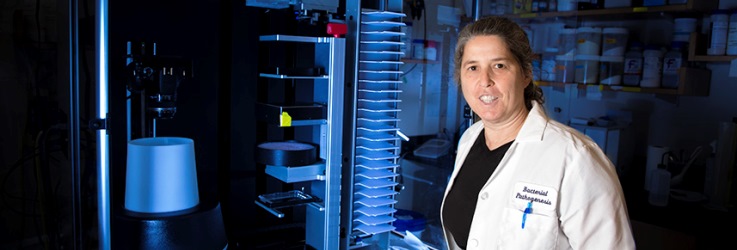
In the battle between bacteria and humans, the best defense may be a good offense. That’s the promising approach being pursued by Cammie Lesser, MD, PhD, a researcher and clinician in the Department of Infectious Disease and a d’Arbeloff MGH Research Scholar at Massachusetts General Hospital.
Lesser is using her MGH Research Scholar funding ($500,000 distributed over five years) to investigate a technique used by harmful bacteria such as Shigella to infect humans and reengineer it to provide a helpful function instead.
She recently published two papers in high impact journals that expand our understanding of how bacteria manipulate cells to cause harm. These findings could lead to new strategies for treating Shigella and other infectious diseases.
What is Shigella?
Shigella is a group of pathogenic bacteria that has evolved over millions of years specifically to infect humans. It is primarily transmitted through contaminated food or water, but it can also be transmitted via surface contact.
Shigella causes shigellosis, a severe type of diarrhea often associated with fevers and stomach cramps that can last from five to seven days. Shigella causes about 500,000 cases of diarrhea in the United States annually. Fortunately, most cases resolve without causing lasting damage.
Worldwide, Shigella is a much bigger problem. It is estimated to cause up to 165 million cases of disease and 600,000 deaths each year, primarily in children under the age of five in developing nations. To add to the challenge, there are new, antibiotic-resistant strains of Shigella emerging that are much more difficult to treat.
How bacteria wreak havoc
Many types of harmful bacteria strains such as Shigella have evolved syringe-like nanomachines that they use to inject molecules directly into human cells. These injected molecules are designed to disrupt a variety of cell functions and many impair the body’s immune response, thus making it easier for the harmful bacteria to spread and infection to develop.
In the case of Shigella bacteria, the molecules act to disrupt normal cell function in the intestine, creating a niche for the bacteria within the cells of the intestinal wall.
Discovery of a new delivery pathway
For many years, it has been thought that all these harmful molecules are escorted to nanomachines via interactions with “chaperone” molecules that help the harmful molecules eventually find their way into host cells.
However, Lesser and her team have found another delivery pathway in Shigella that functions independently of these chaperones. This pathway is likely also common in many other human pathogens.
Their findings could serve as a new target for the development of antibiotics, a pressing need given the increasing incidence of multidrug resistance bacteria that rely on these nanomachines to cause disease.
Read more about this new pathway in Lesser’s mBio paper.
New method for studying bacteria
A key to understanding how bacteria cause infections is to understand what these harmful molecules do to disrupt function in human cells. However, the traditional method of deciphering the function of individual molecules—removing them one at a time and seeing what happens in their absence—can be difficult in the case of pathogenic bacteria, as different types of molecules often work in a redundant manner.
To address this limitation, Lesser and her team developed a way to study these molecules individually. They introduced nanomachines into “good” strains of E. coli bacteria found in the gut that normally do not cause disease. They then added back one harmful molecule at a time into the E. coli bacteria via the nanomachines and investigated what they do.
Using this method, they have uncovered new functions for several Shigella molecules, thus demonstrating the strength of their new approach.
Learn more about this method in their paper published in Proceedings of the National Academy of Sciences of the United States of America.
About the Mass General Research Institute
Massachusetts General Hospital is home to the largest hospital-based research program in the United States. Our researchers work side-by-side with physicians to develop innovative new ways to diagnose, treat and prevent disease.
Support our research


Leave a Comment