
First let’s define a few key words:
- Penicillin: Penicillin is an antibiotic treatment that is effective at getting rid of common bacterial infections and treat skin, ear, sinus and upper respiratory tract infections.
- Cephalosporin and Amoxicillin: Antibiotics similar to penicillin.
What’s the issue researchers wanted to address?
“10 to 15 percent of hospitalized patients have penicillin allergy in their medical record, but studies have shown that more than 95 percent are not really allergic,” explains Kimberly Blumenthal, MD, MSc, of the Division of Rheumatology, Allergy and Immunology, the Medical Practice Evaluation Center, and the Lawrence Center for Quality and Safety at Massachusetts General Hospital.
Furthermore, alternatives to penicillin (called broad-spectrum antibiotics) are less effective, more toxic, more expensive, increase likelihood of antibiotic resistance and can leave patients vulnerable to certain infections. There is a need to address over-reporting of penicillin allergies.
How did they address the issue?
Researchers from Mass General and Brigham and Women’s Hospital developed two approaches – (1) combined use of penicillin allergy skin tests with oral test dose and (2) a computerized guideline – to confirm whether patients previously believed to have a penicillin and cephalosporin allergy were truly allergic to these drugs.
How did they test these approaches?
Over a two-year period, researchers compared treatment approaches for inpatients who needed antibiotic treatment and had a recorded penicillin allergy.
The first five months served as a comparison period during which time patients received standard treatment (broad spectrum antibiotics) with additional skin testing only if physicians consulted a specialist.
For the next seven months, eligible patients received a skin test. Patients whose skin tests were negative and safely tolerated a test dose of amoxicillin were determined not to be allergic.
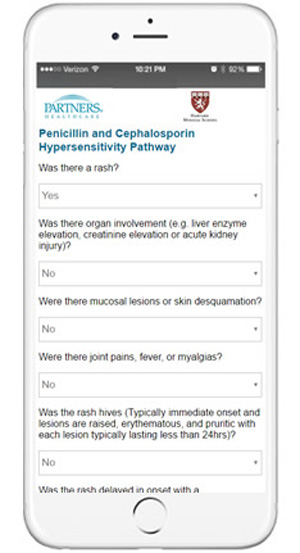
In the final study period, physicians had access to a computerized treatment guideline (see photo) that helped to determine the suitability of penicillin use based on symptoms of the patient’s previous reactions to the treatment. The guideline would recommend either a full dose of broad-spectrum antibiotics, a test dose under observation, or an allergy consultation.
What were the results?
Both tested protocols safely increased the use of penicillin and penicillin-related antibiotics in inpatients. There were barriers that routinely made skin testing impractical.
However, of the 43 patients who did receive skin tests, none proved to have a penicillin allergy, and they were 6 times more likely to receive a penicillin or cephalosporin prescription compared to those that received standard treatment.
112 patients completed the computerized guideline protocol and researchers found that the app safely increased the use of penicillins and cephalosporins almost 2-fold compared to the standard treatment.
What do these results mean?
Both approaches help provide safe and effective treatments to improve the care of patients when they are hospitalized and expand antibiotic choices.
The computerized guideline tool could be especially useful for hospitals with limited ability to adopt a skin testing protocol or lack of access to staff allergy specialists. As this tool becomes more widely available, it may have an even greater effect on antibiotic prescriptions.
Kimberly Blumenthal, MD, MSc, is co-lead and corresponding author of the paper. Rochelle Walensky, MD, MGH Division of Infectious Disease, is senior author.
About the Mass General Research Institute
Massachusetts General Hospital is home to the largest hospital-based research program in the United States. Our researchers work side-by-side with physicians to develop innovative new ways to diagnose, treat and prevent disease.
Support our research


Leave a Comment